

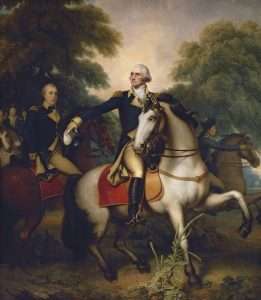
George Washington was appointed commander in chief of the Continental Army to fight the Revolutionary War (1775–1783) in June 1775. A veteran of the Seven Years’ War (1754–1763), Washington brought experience in frontier combat, a preference for disciplined regular troops, and a firm belief in civilian authority over the military. When he arrived at the siege of Boston in July 1775, he confronted an undisciplined force beset by short enlistments. He pushed the Continental Congress to address the army’s structural weaknesses and began building a more permanent force modeled on his earlier Virginia Regiment. After reorganizing the army through the winter of 1775–1776, Washington forced the British evacuation of Boston in March 1776. His decision to defend New York that summer, however, resulted in a series of defeats. Yet Washington preserved the army by avoiding encirclement and retreating across New Jersey.
Facing collapse by late 1776, Washington struck back with the victories in the Battle of Trenton (December 26, 1776) and the Battle of Princeton (January 3, 1777), reviving Patriot morale, influencing British strategy, and restoring his reputation as commander. In 1777, he sought to defend Philadelphia but suffered tactical defeats at the Battle of Brandywine (September 11, 1777) and the Battle of Germantown (October 4, 1777). Washington spent the winter of 1777–1778 at Valley Forge, where shortages threatened the army’s survival, but reforms directed by Baron von Steuben strengthened training and discipline. In June 1778, Washington’s army fought the British to a standstill at the Battle of Monmouth (June 28, 1777), demonstrating its improved capabilities and marking the end of serious challenges to his leadership. A long stalemate followed. Washington balanced the demands of frontier warfare, supply shortages, mutinies, and the arrival of French forces under Rochambeau. British interest in capturing him and Benedict Arnold’s treason revealed Washington’s continuing symbolic importance to both sides.
By 1781, shifting strategic conditions drew Washington south. Learning that French naval forces would control the Chesapeake Bay, he marched to Virginia, where combined Franco-American forces besieged Lord Cornwallis at Yorktown (September 28–October 19, 1781). The British surrendered on October 19, 1781, effectively ending major combat operations.
With the signing of the preliminary peace in 1783, Washington announced the end of the war, took farewell of his officers, and resigned his commission. Although Washington suffered significant defeats and was not a tactically exceptional battlefield commander, he possessed the qualities necessary for ultimate victory: steadiness under pressure, political judgment, personal courage, and the ability to sustain the confidence of soldiers, Congress, and France. His leadership was indispensable to the success of the American Revolution.


