


Virginia in the Seven Years’ War
The Seven Years’ War, better known in Britain’s former American colonies as the French and Indian War, raged across five continents from 1754 to 1763. Virginians played a significant role in shaping the conflict, which in turn had a profound impact on Virginia, helping to prepare the ground for the American Revolution.

For many Virginians, the focus of the Seven Years’ War was land, especially the fertile floodplains of the Upper Ohio Valley—hunting grounds for the Cherokee, as well as their frequent enemies, the Shawnee and the Delaware. This region was also claimed by the Six Nations of the Iroquois, or Haudenosaunee, by a supposed right of conquest. Virginia’s claim was also contested by neighboring Pennsylvania—and especially by New France (present-day Canada).
The conflict began when Virginia governor Robert Dinwiddie sent a regiment of approximately 300 soldiers to drive a French force from the forks of the Ohio—where the Allegheny and the Monongahela rivers meet to form the Ohio River (present-day Pittsburgh). Serving as second in command, twenty-two-year-old George Washington led an advance detachment that, on May 28, 1754, surprised a French party and forced it to surrender. Washington’s Haudenosaunee guide and ally, Tanaghrisson, then killed the French commander, Joseph Coulon de Jumonville. Learning that a larger French force was headed their way, the Virginians built a stockade, Fort Necessity. Washington surrendered it on July 4, signing a document in French (a language he did not read) that described Jumonville as a diplomat and referred to his death as an “assassination.”

In 1755, the British government sent General Edward Braddock and approximately 2,000 regular troops, soon joined by hundreds of Virginians, including Washington, to drive the French from the region. But on July 9, 1755, Braddock’s army encountered a French detachment and its Native allies. In the ensuing battle, Native warriors killed, captured, or wounded two-thirds of the British force with token aid from the French.
Indigenous warriors also attacked Virginians and Pennsylvanians who had settled on their lands. But over the next three years, many of France’s Native allies withdrew from the conflict. Like the colonists, they depended on European ironware and textiles, and British-manufactured goods often surpassed those of France in both price and quality. Moreover, British Indian agents promised Native peoples perpetual possession of lands west of the Appalachian Mountains. With dwindling Indigenous support, the French were driven from the Upper Ohio Valley in 1758 and mainland North America in 1760.
Parliament’s Rebellion Against the Old British Empire
Britain’s grand triumph over the French, sealed in a February 10, 1763, peace treaty, set in motion a process that would end two decades later in its defeat at the hands of its own colonists. The expulsion of the French filled many free Virginians with gratitude for the mother country. But most members of Parliament believed the war had exposed serious weaknesses in the empire. They demanded change in four crucial areas, summarized as the four Ts: territory, taxes, trade, and treasury notes. Parliament’s efforts to reshape imperial policy after 1763 elicited angry protests from free Virginians, and these in turn prompted the mother country to inflict harsh punishments on the colonies. Parliament’s punishments did far more than its earlier attempts at reform to drive Virginians and other colonists out of the empire.

One flashpoint was territory. To many free Virginians, news of the 1763 peace treaty sounded like a starter’s pistol, setting off a scramble for the territory that France had just relinquished. Virginians’ encroachment on Native lands provoked many of them to join in an uprising known today as Pontiac’s Rebellion, when Native warriors captured nine western forts and penetrated as far east as Winchester, killing many settlers and taking others captive.
The Seven Years’ War and Pontiac’s Rebellion complicated relations between free and enslaved Virginians. Some African Americans believed they might gain their freedom if the French conquered Virginia. Enslaved people in King George County assembled for what Governor Dinwiddie and other whites feared was an insurrection. Eight years later, during Pontiac’s Rebellion, Native raiders alarmed whites by “saving & Carressing all the Negroes they take,” according to militia surgeon William Fleming.

Britain sent troops to put down Pontiac’s Rebellion. But in hopes of never having to absorb that enormous expense again, the imperial government issued the Proclamation of 1763 to prevent colonial settlement west of the Appalachian Mountains, including Kentucky and the entire Upper Ohio Valley. This infuriated Virginia land speculators like Washington, Thomas Jefferson, James Madison, and Patrick Henry, who hoped it was, as Washington termed it, “a temporary expedient to quiet the Minds of the Indians.”
On December 13, 1769, the House of Burgesses petitioned the king to revoke the Proclamation Line. By that time, there were rumors of attempts to reassemble the Pontiac coalition. Fearing what the Earl of Hillsborough, the secretary of state for the American colonies, called a “general Indian War, the expense whereof will fall on this Kingdom,” British officials stuck by the Proclamation of 1763, helping to stave off a major conflict. But by keeping its promise to the Native peoples, the imperial government damaged its relations with its own colonies, as would become evident in the Declaration of Independence, which denounces taxation without representation once but the British effort to halt settler colonialism three times.
Britain also shocked its colonists by leaving 10,000 soldiers in America at the end of the Seven Years’ War. They were tasked with preventing rebellions by enslaved laborers in the Caribbean, by recently acquired subjects in Quebec, and by Indigenous warriors. Redcoats deployed to the western frontier would actually have a double assignment according to British general Thomas Gage: “awing as well as protecting the Indian nations” from American settlers’ westward expansion.

To pay for those 10,000 troops, Parliament levied two new taxes on the Americans: the Sugar Act in 1764 and the Stamp Act in 1765. Thus, Indigenous peoples figured prominently both in Britain’s attempt to rein in the colonists’ westward expansion and in its decision to tax them.
The Sugar Act was also part of a parliamentary campaign to regain control of the colonists’ trade. North Americans routinely imported molasses from other empires’ Caribbean colonies in violation of Britain’s Navigation Acts. By cracking down on molasses smuggling, Parliament also harmed the many Americans, including a growing number of Virginians, who raised commodities like livestock and especially grain to feed people enslaved in the Caribbean.
The fourth and final T where Parliament demanded change in the 1760s was treasury notes, better known as paper money. Angry at the Americans for repaying their debts with depreciated colonial currency, British merchant-creditors persuaded Parliament to pass the Currency Acts of 1764 and 1773, prohibiting any colony from requiring creditors to accept its paper money at face value.
The Colonists Strike Back
Parliament’s territorial, tax, trade, and treasury-note initiatives impelled free Virginians into a wide variety of protests. The House of Burgesses sent numerous petitions to England. As in other colonies, a crowd nullified the Stamp Act by forcing Virginia’s stamp agents to resign under threats of violence. In addition, the courts closed to avoid using stamped paper—and incidentally to provide welcome, if temporary, relief to delinquent debtors suffering through a ruinous post-war recession.
Free Virginians also refused to purchase British merchandise. George Washington emphasized that the boycott, widely known as the Association, would yield personal as well as public benefits. In an April 5, 1769, letter to George Mason, Washington noted that many Virginians had gone deep into debt to live opulently, both to keep up with the Joneses and to sustain their credit ratings. The Association offered an escape from that spiral, he observed. It gave “the extravagant & expensive man” a “pretext to live within bounds”—an excuse to trim expenses without damaging his reputation or credit rating. After Norborne Berkeley, baron de Botetourt, the royal governor, adjourned the House of Burgesses for its most recent criticism of Parliament, the burgesses took the lead in spreading the Association throughout the colony.

In 1773, the House of Burgesses deepened its resistance to Parliament’s initiatives by forming a committee of correspondence to coordinate with the other colonies, most of which followed suit. The following year, Parliament punished Massachusetts for the Boston Tea Party with legislation that colonists called the Intolerable Acts. Sister colonies retaliated in numerous ways. Perhaps most significantly, they renewed and enlarged their boycott of British trade, from which they once again expected personal as well as public benefits. During the summer of 1774, Virginians and Marylanders halted nearly all of their British imports, pressuring Parliament while also reducing their debts.
At Virginia’s instigation, colonial protesters also brought out a new weapon. After a recession robbed tobacco of 40 percent of its value, a Patriot convention, meeting in Williamsburg in August 1774, proposed to halt tobacco exports, starting a year later. That put pressure on British tobacco importers—and through them, on Parliament. It also pulled the price of tobacco out of its slump. In tandem, nonimportation and delayed nonexportation gave colonial Virginia its largest trade surplus to that point.
In September and October 1774, the trade boycott was endorsed by the First Continental Congress in Philadelphia. The delegates urged every town in America to form a committee to enforce the boycott. They also adopted other protest measures, including a ban on the importation of enslaved Africans that the General Assembly would codify four years later and never repeal. Although initially staffed by members of the gentry, many of these local committees escaped their control and proceeded to handle violators—and later, Loyalists—so roughly as to alarm the gentry.
Even as the members of Congress deliberated, free Virginians and Governor Dunmore set aside their differences for an attack on the Native tribes of the Upper Ohio Valley. Dunmore’s War forced Native peoples to cede the entire region east of the Ohio River—modern-day western Pennsylvania, West Virginia, southwest Virginia, and Kentucky.
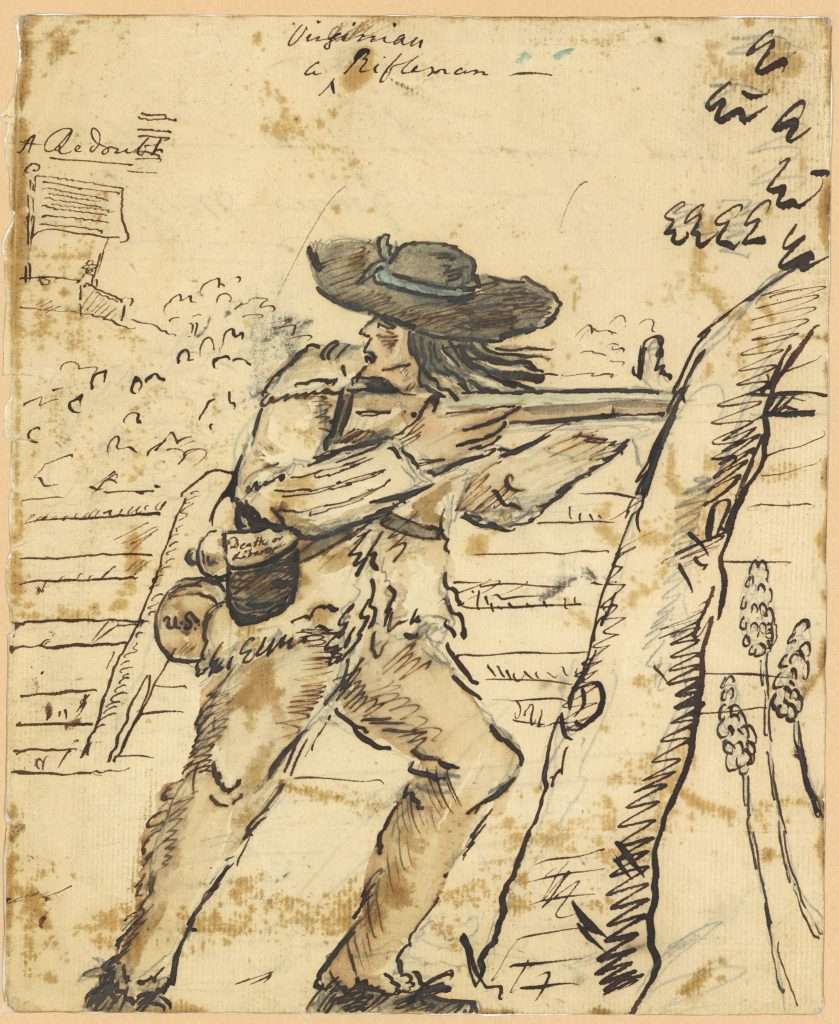
Also in fall 1774, Virginians began forming independent companies of volunteer soldiers. Like the local committees, some of the independent companies got out of hand, at least from the gentry’s perspective, but they were endorsed by the Second Revolutionary Convention, which met at St. John’s Church in Richmond from March 20–27, 1775, the occasion of Patrick Henry’s famed “Give me liberty or give me death” speech.
In the summer of 1775, yet another Virginia convention formed a new military establishment centered on battalions of minutemen. Soldiers were only paid for the days they actually served or trained, yet these came often enough to prevent minutemen from running their farms. The result was mass resistance to minutemen service—the first sign of a pattern of draft resistance that would continue in Virginia and elsewhere throughout the war. Later that year, in another sign of discontent with the upheavals of war and the existing economic structure, insurgent tenant farmers refused to pay rent and other debts.
Meanwhile, Congress had made George Washington the commander in chief of the Continental Army. He reached headquarters in Cambridge, Massachusetts, on July 2, 1775—exactly a year before the Second Continental Congress declared independence.
Black Initiative, British Retribution, White Independence
In November 1774, nearly a year before the war came to Virginia, African Americans began discussing how to use the growing conflict between white Loyalists and Patriots to gain their own freedom. In April 1775, whites circulated more rumors of slave insurrections than in any previous month in Virginia history. By summer, African Americans were offering to fight for Governor Dunmore in return for their freedom. He turned them away at first but eventually accepted them. When Joseph Harris, an enslaved river pilot, escaped to the British warship called the Liberty, Patriots demanded his return, but the captain refused to give him up. The result was the Battle of Hampton (October 27, 1775), the first Revolutionary War battle fought south of New England.

Dunmore formed his Black soldiers into what he called his Ethiopian Regiment, which on November 15, 1775, defeated the Princess Anne County (present-day Virginia Beach) militia at Kemp’s Landing near Norfolk. The Patriot commander, Joseph Hutchings, was captured by his own formerly enslaved laborer. That same day, Dunmore published his previously written emancipation proclamation, promising freedom to any rebel’s enslaved person who was “able and willing to bear Arms.” That phrase implied men, but about half of the Black Virginians who escaped to Dunmore were women and children.
Dunmore infuriated white Virginians by, as Archibald Cary put it, “pointing a dagger to their throats, thru the hands of their Slaves.” In his rough draft of the Declaration of Independence, Thomas Jefferson’s longest and most passionate complaint against the king, the only one where he called George III a bad Christian and used all caps for emphasis, was that he had “obtruded” slaves on white Virginians and then, in 1775, incited them to murder their enslavers. Washington, Jefferson, Henry, and thousands of other Virginia enslavers would lose human property to the British.

Patriot troops marched toward Dunmore’s stronghold at Norfolk and, on December 9, 1775, met Dunmore’s army at the Battle of Great Bridge over the south fork of the Elizabeth River. The British would have preferred to remain on the defensive, forcing the Patriot army to cross the bridge and a long causeway without cover. But the British commander concluded that he did not have that luxury, since 500 Patriot reinforcements from North Carolina, armed with cannon, were only a day away. He sent his regulars and Loyalist militia forward, and they suffered approximately 50 percent casualties before withdrawing.
The British failure at Great Bridge forced Dunmore to evacuate Norfolk. Borrowing and confiscating vessels for his Black and white troops and the hundreds of civilian Loyalists who had joined him, the governor created a floating community. After the Patriots occupied Norfolk, the British fleet opened fire on the waterfront on January 1, 1776, and Dunmore sent crews ashore to burn some of its most important buildings. Patriots burned the rest, claimed Dunmore had done so, and added the burning of Norfolk to their list of his alleged war crimes.

Disease spread quickly in the close quarters of Dunmore’s ships. Many of his white troops had been inoculated against smallpox, but few of the Blacks troops had been, so he had them immunized, but not before many died of the disease. There was no defense against other diseases like malaria, dysentery, typhus, and typhoid fever. Forced to send his troops ashore, Dunmore first chose Tucker’s Mill, at the mouth of the Elizabeth River opposite Norfolk, and then Gwynn’s Island in the Chesapeake Bay between the York and Rappahannock rivers—both of which were within range of Patriot cannon. Dunmore finally found a measure of security on St. George’s Island near the Maryland side of the Potomac River, but in August the epidemics ravaging his fleet forced it to depart for New York.
Independence: Virginians at the Forefront
Meanwhile, Virginia’s Fifth Revolutionary Convention turned the colony into a commonwealth. On June 12, the delegates approved George Mason’s Declaration of Rights, but only after making an important addition. Mason had written that “all Men are by nature equally free and independent,” a phrase several other states’ constitutions, including Massachusetts’, would borrow. But Mason’s colleagues pointed out that his language could be interpreted as prohibiting slavery (as in fact the Massachusetts Supreme Judicial Court would rule in 1783 in Commonwealth v. Jennison). So, the Virginia convention qualified it, saying natural rights only applied when people “enter into a state of society.” That caveat violated John Locke’s principle that all humans receive their natural rights at birth, but it clarified the convention’s intentions regarding the enslaved population.
The delegates adopted Virginia’s first constitution on June 29, 1776, four days before Congress declared independence. The new government was a mixed bag, retaining the old property qualification for voting but requiring every member of the House of Delegates to face the voters every year. The governor lost his power to veto legislation, and he would henceforth be elected by Virginians, but by the General Assembly, not by citizens.

Many well-to-do Virginians embraced independence for practical reasons, in hopes of obtaining a French alliance and restoring order by reestablishing formal government. But the final break also had an emotional component: free Virginians’ anger at the British for cooperating with Native Americans and African Americans, for sending German mercenaries to fight Americans, and for allegedly burning Norfolk. While the colonists had not forgotten about territory, taxes, trade, and treasury notes, these original issues faded into the background when Virginians’ protests against them led to Parliament “declaring war against us,” as the Declaration of Independence alleged.
The Declaration of Independence owed more to Virginia than to any other colony, from the Fifth Revolutionary Convention’s instructions to its delegates to the Constitutional Convention to propose independence to Jefferson’s draft of the Declaration.
Women, Rights, and War
From 1776 on, white women sought greater inclusion in Virginia. Some elite women, including Hannah Lee Corbin and Mary Willing Byrd, hoped to gain formal political participation and voting rights as a result of the war with Britain. The Virginia Constitution of 1776 limited suffrage to adult white male property owners who owned either 100 acres of land or 50 acres with a dwelling. Although the system of coverture prevented married women from owning property—all rights passed to the husband upon marriage—single women and widows could legally own property. After the Revolution broke out, many female Virginia property-holders protested their unequal status and their inability to vote. Corbin, a widow and the sister of prominent Virginia politician Richard Henry Lee, embraced the Patriots’ slogan “no taxation without representation,” protesting to her brother that just as Parliament was levying taxes upon British American colonists without commensurate representation in the House of Commons, so too were women being taxed without the right to vote. While Lee privately conceded that the “doctrine of representation” did not “forbid Widows having property from voting,” he never made this point publicly.
Likewise, Mary Willing Byrd, the wealthy widow of William Byrd III, began to question why property-holding women could not claim the same rights as men. Accused of consorting with the enemy after turncoat British general Benedict Arnold and his troops ransacked her plantation at Westover and confiscated enslaved people, boats, and horses, she forcefully asserted her patriotism but lamented that her gender limited her political participation and stymied her efforts to recoup property stolen during the war.
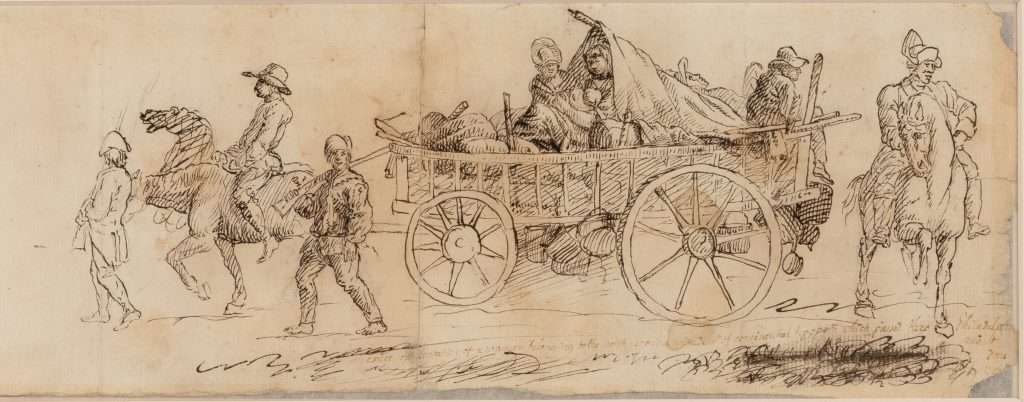
Other women, both middling and elite, sought out new military roles during the war. Like other spouses of Continental Army officers, Martha Washington, the wife of General George Washington, used her position to increase troop morale and support her husband during a long, and at times seemingly hopeless, war with Britain. Many other white women joined the army as camp followers—or Women of the Army—licensed vendors who sold goods to soldiers, civilian employees such as nurses, or the wives of soldiers who ensured the Continental Army functioned on a daily basis. They cooked soldiers’ meals, cleaned the camps, mended uniforms, and nursed the sick and wounded. By serving as laundresses, women helped curtail the spread of deadly diseases like typhus, also known as “camp fever,” which was transmitted by body lice. When the Continental Army saw action in Virginia, women played crucial behind-the-scenes roles in achieving victory.
The Articles of Confederation (1777)
In December 1777, Virginia became the first state to ratify the Articles of Confederation, the initial constitution of the United States. For nearly a year and a half after the Continental Congress declared the thirteen colonies “free and independent states” with no “political connection” to Britain, the proposed articles were mired in debate about the type of confederacy that would bind the new states in “perpetual union.” Lawmakers disagreed about voting, representation, taxation, and western land claims. The delegates finally struck a deal in October 1777. Congress then pressured each state “to give it speedy consideration and return,” since the Articles of Confederation, as they were called, could only become law after unanimous approval. Led by Virginia, most states complied with Congress’s demand, ratifying the articles by early 1778. But Maryland, Delaware, and New Jersey remained holdouts, refusing to ratify the articles as long as Virginia maintained its vast land claim to much of the Ohio River Valley. While New Jersey and Delaware eventually capitulated in late 1778 and early 1779, Maryland did not ratify the articles until 1781, after British raids on its coasts. As a result, for nearly the entire Revolutionary War, the new United States prosecuted a war against one of the world’s most powerful empires without a constitution.
The Franco-American Alliance (1778)
In February 1778, the three American commissioners representing the fledgling American nation in Paris negotiated one of the most important diplomatic agreements of the Revolution. One of these diplomats was Virginian Arthur Lee. The Continental Congress appointed Lee as an envoy to Spain and Prussia and also tasked him with spying informally in London. After news of the Continental Army’s decisive victory at the Battles of Saratoga (September 19 and October 7, 1777) reached Versailles, Lee and fellow commissioners Silas Deane and Benjamin Franklin secured a “treaty of amity and commerce” with France that transformed the war from a colonial tax revolt into a global war for empire. The treaty recognized the United States as an independent state and promoted commerce between France and America. It also furnished much-needed military supplies, troops, and loans to the Americans to support the war effort. Moreover, the agreement enabled other European powers to join the alliance—Spain did so on June 21, 1779, when it formally entered the war against Britain, albeit without allying with the United States. These crucial alliances broadened the war’s scope as conflict expanded to the West Indies, the Mediterranean, the northern coast of Africa, and beyond.
The Convention Army in Charlottesville
The Battles of Saratoga also had a direct impact in Virginia. In early 1778, nearly 4,000 Hessian and British prisoners of war captured by American troops at Saratoga arrived at the Albemarle Barracks in Charlottesville after a 700-mile trek from Massachusetts. They were known as the Convention Army because the troops had surrendered under a convention brokered between British and American military leaders, under the terms of which British troops would return home and not serve again in the conflict. But the Continental Congress balked at the agreement, leaving the prisoners in limbo. The prisoners of war were initially held in Massachusetts, but Americans worried that their countrymen would try to liberate them. At the behest of John Harvie, a Virginia delegate to the Continental Congress, the Convention Army was directed to march south to Albemarle County, where they would live rent-free on Harvie’s land in exchange for making agricultural improvements. Though many Virginia politicians believed that the Convention Army’s presence would boost Virginia’s economy and enable the Patriots to treat enemy prisoners more humanely by providing adequate food and shelter, the troops encountered poor conditions and did not remain in central Virginia for long. In the fall of 1780, as British troops stormed their way north to Virginia from the Carolinas, the Convention Army was again relocated, this time to Frederick, Maryland.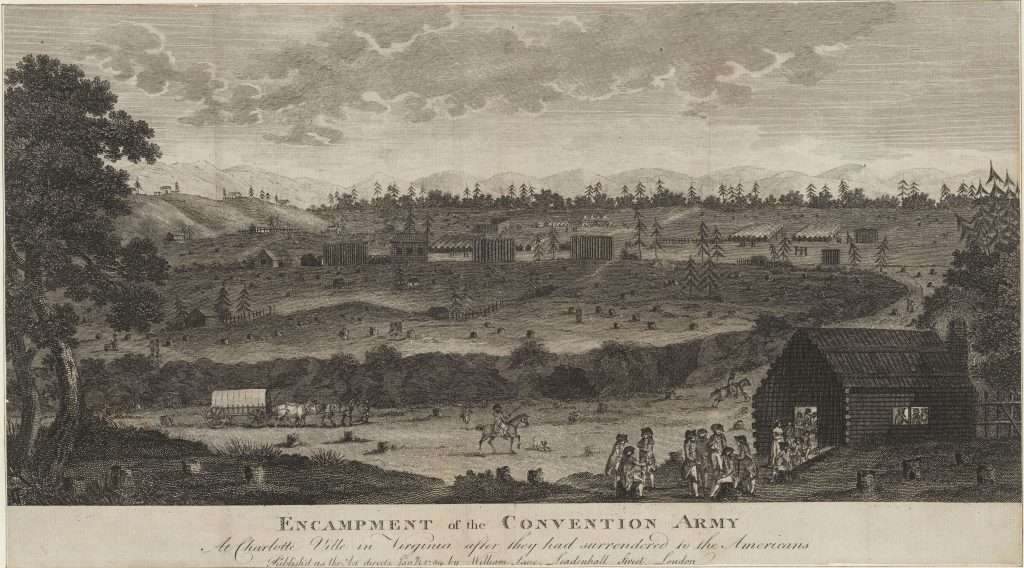
Virginia, Native Americans, and the Western Theater of War
In 1779, George Rogers Clark, a Virginia surveyor and a militia officer, captured Fort Vincennes, a British fort along the Wabash River on the modern Indiana-Illinois border. Clark’s victory was important for two reasons. It consolidated and legitimized Virginia’s authority over a vast swath of territory that stretched from the Atlantic Ocean to the Great Lakes. And it struck a blow to British and Native control over lands west of the Appalachians, where King George III had attempted to limit white settlement with the Proclamation of 1763.
General Washington praised Clark’s victory at Vincennes, envisioning it as a prelude to a broader western campaign to “gain possession” of Detroit and “effectually secure the friendship or at least the neutrality of most of the Western Indians.” The Patriots failed to capture British-held Detroit during the war, but Clark’s victory enabled the General Assembly to create—and declare sovereignty over—the Illinois Country and the Native Americans who lived there until 1784, when Virginia ceded the territory to the U.S. federal government as the Northwest Territory.
The British Raid on Richmond
In May 1779, British forces sailed from New York City to Portsmouth, where they burned Suffolk and destroyed or seized Patriot property, including around 1,000 enslaved African Americans, before withdrawing two weeks later. Just after New Year’s Day 1781, now-British general Benedict Arnold sailed up the James River with 1,500 British regulars, Hessian mercenaries, and Loyalist militia in Britain’s first attempt to raid Virginia in eighteen months.

Arnold’s orders from General Sir Henry Clinton were strategic and clear—he and his men were to destroy Patriot arms and munitions in central Virginia, setting the stage for Cornwallis’ expected overland invasion from the Carolinas. After landing at Westover, a plantation owned by the prominent Byrd family, Arnold and his troops marched toward the new capital of Richmond, which had only recently been moved from Williamsburg to place it beyond the reach of British warships. There, Arnold offered an ultimatum: British forces would spare the city if residents and officials handed over tobacco and other goods. Governor Thomas Jefferson refused; Arnold directed a rampage through the city. Troops broke off the trunnions of cannon, dumped hundreds of barrels of gunpowder into the James River, and burned (and exploded) powder magazines. They destroyed warehouses, public buildings, and shipbuilding workshops, and seized dozens of Patriot ships, loading them with stolen tobacco. They also seized enslaved people whom fleeing Patriots—including Jefferson—left behind. Jefferson lamented to General Washington that within “48 hours from the time of their landing … they had penetrated 33 miles, done the whole injury and retired.”
By the time it became clear that Arnold intended to attack Richmond, Jefferson had little time to mobilize the Virginia militia. But militiamen were also increasingly unwilling to answer the governor’s call to fight. Since 1778, the General Assembly had implemented mandatory conscription, and ordinary Virginians had resisted the unpopular draft, particularly as the war dragged on and swung south to the Carolinas. Jefferson faced a torrent of criticism for his failure to stop Arnold’s advance and for his flight to Charlottesville—along with the state legislature—during the British raid.
Arnold was joined by Major General William Phillips and an additional 2,000 British troops who clashed with forces under Prussian-born Continental Army major general Frederick Wilhelm Augustus von Steuben at the Battle of Petersburg on April 25, with Steuben ordering a strategic retreat to preserve Continental forces and morale.
The Yorktown Campaign
The Yorktown Campaign and the decisive battle of the American Revolution began with Cornwallis’s arrival in Virginia on May 20, 1781. Cornwallis hoped to engage the Patriots in battle or cut off their supply lines to pressure American troops to the south. After arriving in British-occupied Petersburg and learning of General Arnold’s successful raid on Richmond and the flight of the governor and legislature to Charlottesville, Cornwallis sent some of his 1,500 troops west on June 3. Lieutenant Colonel Banastre Tarleton’s cavalry went in pursuit of Virginia officials. They took Charlottesville but failed to capture either Governor Jefferson, who narrowly escaped and fled to Poplar Forest, or the state legislators, who crossed the Blue Ridge Mountains to Staunton.
Tarleton’s failure to capture Patriot leaders forced Cornwallis and his forces to backtrack eastward, breaking their journey at Jefferson’s Elk Hill plantation in Cumberland County. There, they destroyed Jefferson’s crops, burned his barns and fences, appropriated livestock and horses, cut the throats of those animals “too young for service,” and “carried off” nearly thirty enslaved people. Cornwallis and his men continued to plunder plantations and seize enslaved people as they marched toward the Tidewater; by mid-July, they were in Portsmouth.
Meanwhile, Lieutenant Colonel John Graves Simcoe, who commanded the Loyalist Queen’s Rangers, captured Point of Fork, a critical Patriot supply depot on the James River, on June 5. On June 26, Simcoe’s troops clashed with American forces under Colonel Richard Butler at the inconclusive Battle of Spencer’s Ordinary. The Continentals, led by the Marquis de Lafayette and now reinforced by Brigadier General Anthony Wayne, shadowed Cornwallis’s troops but avoided significant combat until the Battle of Green Spring on July 6, when British forces ambushed Lafayette and Wayne at Green Spring Plantation in James City County. Only a daring bayonet charge by Wayne prevented disaster, and the American forces retreated to Richmond.
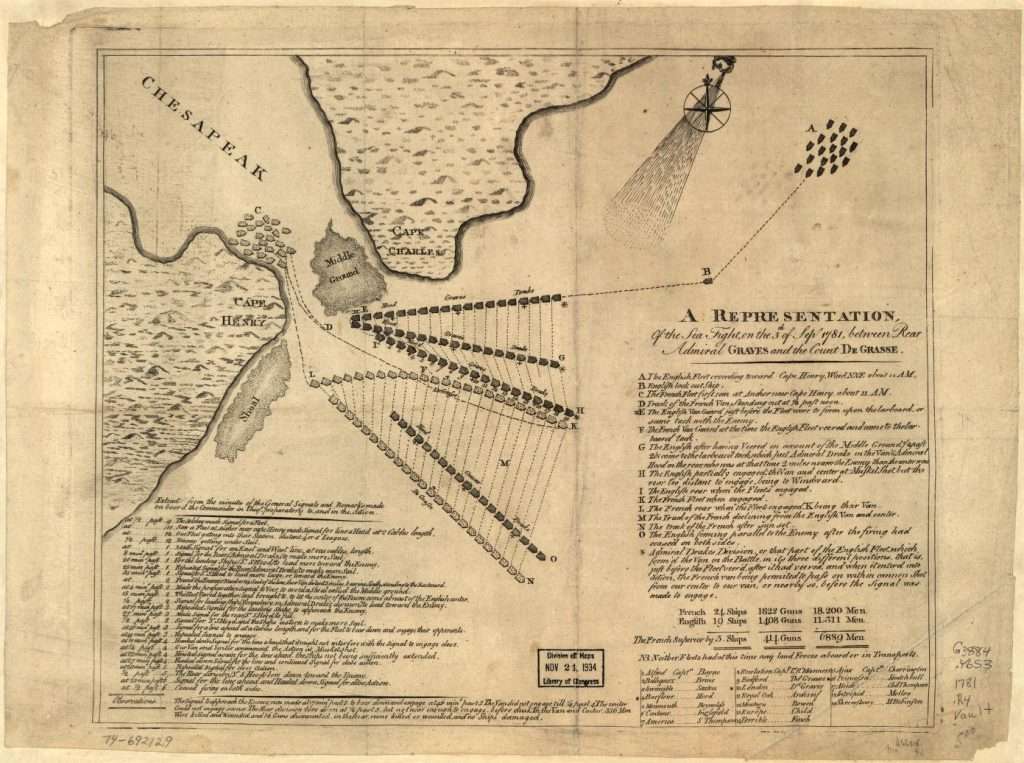
General Clinton sent Cornwallis new orders—he was to build a British defensive base in eastern Virginia. Though Clinton suggested Old Point Comfort at the tip of the Virginia peninsula, Cornwallis chose to fortify Yorktown and Gloucester, which faced each other across the York River. The fortifications were complete by August; there were about 7,200 British, Hessian, and Loyalist forces in the two occupied towns. Meanwhile, General Washington and General Rochambeau, who had planned to attack British-held New York, abandoned this plan and directed the Continental Army south, where they hoped to trap Cornwallis. Two French fleets, one from the West Indies commanded by Admiral de Grasse and one from Newport, Rhode Island, commanded by Admiral de Barras, converged on the Chesapeake. De Grasse’s fleet reinforced Lafayette’s Continentals near Williamsburg while de Barras’s fleet delivered heavy artillery and then remained on the coast to blockade the British. Two British admirals, Sir Samuel Hood and Thomas Graves, dispatched their fleets from New York to the Chesapeake. In early September, British vessels tried to break through the French line during the Battle of the Capes. Unable to do so, the British fleet returned to New York, leaving Cornwallis isolated and encircled by 16,000 Continentals. On October 3, defeat at the Battle of the Hook, a cavalry battle between the Franco-American force and British troops under Tarleton, blocked Cornwallis’s escape.

Led by generals Washington, Rochambeau, and Lafayette, Continental troops constructed lines outside Gloucester and Yorktown. On October 9, 1781, the Continental Army unleashed a massive artillery attack; it took only a week, until October 19, for Cornwallis and his trapped and starving men to surrender.
Under the terms of the Articles of Capitulation, approximately 8,000 British prisoners—Loyalists, British regulars, and Hessian mercenaries—were imprisoned in Winchester and Fort Frederick, Maryland. But the nearly 4,000 enslaved people seized by Cornwallis and his forces received no protection as prisoners of war. On October 25, General Washington transformed the Continental Army into a band of slave catchers, mandating that all Black people who had escaped to British lines be rounded up and garrisoned near the York River. Among the promoters of American liberty who had enslaved people returned to them the war were Washington, Patrick Henry, and Thomas Jefferson, who recovered several members of the Hemings and Granger families.
Though the battle of Yorktown did not end the war, the American victory boosted morale and consolidated Washington’s authority over the Continental Army, ensuring that he could quash mutinies in the ranks and prosecute the remainder of the war. Yorktown also persuaded the British Parliament to cease offensive operations in America. The last battle of the global war would be fought between the British and the French in Cuddalore, India, in the summer of 1783, shortly before news of peace arrived.
Peace and the End of War, 1781–1783
The Treaty of Paris of 1783, signed on September 3, 1783, ended the civil war between Britain and the United States. Three American diplomats—John Jay, Benjamin Franklin, and John Adams—secured a peace agreement under which Britain formally recognized America as a separate and sovereign nation. King George III acknowledged that all thirteen former colonies were now “sovereign and Independent States” and relinquished “all claims to the Government, Propriety, and Territorial Rights” of his former holdings. Although the Declaration of Independence had boldly claimed America to be an independent “people” rather than a colonial outpost of the British Empire, it was the Treaty of Paris that legally secured the nation’s sovereign status. While George III could have simply recognized the independence of the states, under pressure from American negotiators and as a check on the Spanish, he went a step further and acknowledged the entire trans-Appalachian West—bordered by the Great Lakes, the Mississippi River, the Appalachian Mountains, and Spanish Florida—as the domain of the United States. For Virginia, this was one of the most important concessions of the Anglo-American treaty. While Virginia had claimed the Illinois Country since 1779, the Treaty of Paris legitimized Virginia’s control over these lands, although their Indigenous inhabitants continued to defend their territory well into the nineteenth century.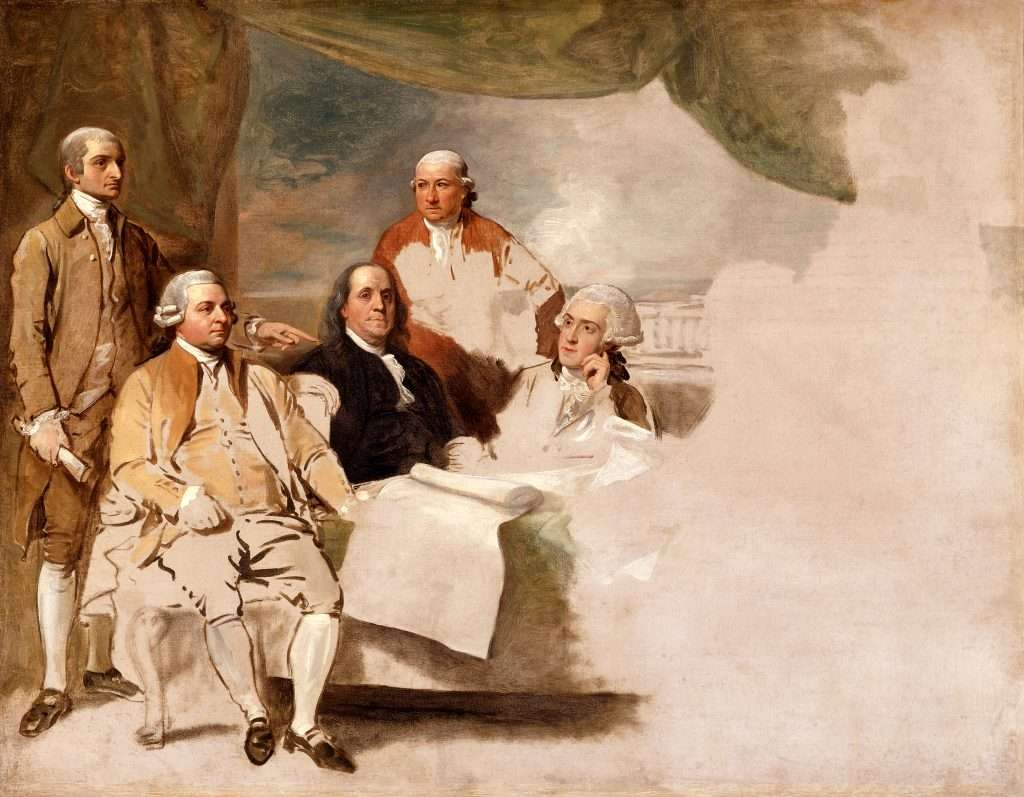
The treaty signed in Paris may have ended the war, secured independence, and confirmed Virginia’s control over vast western territories, but establishing peace proved more complex. The new state government created in 1776 by the Virginia Constitution had been a wartime government—it remained to be seen whether the legislature could rule effectively and democratically in peacetime. After Cornwallis’ surrender, the legislature and courts went to great lengths to protect and restore Virginians’ property rights (including their enslaved property), banish enemies of the state, and reward military service and pre-Revolutionary land speculators. In May 1782, lawmakers committed to aid Virginians in the “recovery of slaves, horses, and other property” that had been “lost during the war.” After a Virginian offered evidence of property ownership, local justices of the peace issued a warrant for the lost property while county sheriffs recovered livestock or human property. In 1783, legislators approved manumission for enslaved people who had served the Patriot war effort. Black men who “contributed towards the establishment of American liberty and independence,” lawmakers declared, should “enjoy the blessings of freedom as a reward for their toils and labours.”

Between 1781 and 1783, one of the most vexing questions facing Virginia lawmakers was how to end a persistent civil war between Loyalists and Patriots. “The Tories and Refugees are still unpunished,” wrote one official in Surry County, and “if some examples are not made, the encouragement is too great for many to withstand the temptation.” Many Patriots took matters into their own hands, tarring and feathering or even murdering Loyalists. To assert its legitimacy and consolidate the rule of law, the General Assembly first attempted to erect special courts to try Loyalists but, thwarted by procedural difficulties, endeavored to try them at the General Court instead. But the state ultimately failed to create a legal mechanism to prosecute Loyalists for treason and instead turned to forcing Loyalists into exile and barring their return.


