Author: Gwendolyn White

ENTRY

William Henry Fitzhugh (1792–1830)

William Henry Fitzhugh was a philanthropist, author, orator, and a veteran of the War of 1812 who manumitted in his will the men and women he enslaved. Fitzhugh was a member of the Virginia House of Delegates (1811–1816, 1828–1829) and the Senate of Virginia (1819–1822) and attended the Convention of 1829–1830. He was born in Stafford County in 1792, the youngest child and only son of Ann Randolph Fitzhugh and William Fitzhugh, a patriot and member of the Continental Congress. Fitzhugh attended the College of New Jersey (later Princeton University) and received a bachelor of arts degree in 1808. He inherited his father’s extensive land holdings in Virginia when William Fitzhugh died in 1809. Although a slave owner, Fitzhugh was a strong supporter of the American Colonization Society and served as its vice president in the 1820s. He married Anna Maria Goldsborough of Maryland in 1814 and the couple resided at the Ravensworth estate in Fairfax County. Fitzhugh died unexpectedly in 1830 at the age of thirty-eight, probably of an aneurysm. His will stipulated that his enslaved workers were to be freed in 1850 and his widow honored his wishes.

ENTRY
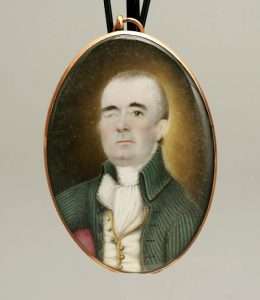
William Fitzhugh of Chatham (1741–1809)

William Fitzhugh of Chatham was a wealthy Virginia planter, politician, and civic leader, descended from one of the colony’s earliest and most prominent families. He was born on September 4, 1741, in King George County, the only son of Henry Fitzhugh and Lucy Carter Fitzhugh, daughter of Robert “King” Carter. His father died when he was an infant, and a childhood accident left him blind in one eye. Educated at home under tutors, Fitzhugh inherited vast estates—including Eagle’s Nest, Somerset, and extensive lands in Fairfax County—making him one of the richest men in Virginia. In 1763 he married Ann Randolph, a cousin of Thomas Jefferson. The couple later built the grand Georgian mansion Chatham, overlooking Fredericksburg, which became famous for its hospitality. More than 100 enslaved people worked the plantation, cultivating crops and practicing skilled trades. Fitzhugh was also a noted horse breeder and racer, corresponding with both Jefferson and George Washington about horses. A supporter of the Patriot cause, Fitzhugh represented King George County in the House of Burgesses (1772–75), attended the Virginia Conventions of 1775 and 1776, and held numerous posts during and after the Revolution—including delegate to the Continental Congress (1779), member of the House of Delegates (1776–1777, 1780–1781, 1787–1788), and state senator (1780–85). After the war, Fitzhugh continued in public life, serving as a presidential elector in 1789. The financial burden of entertaining guests at Chatham eventually led him to relocate to Fairfax County and Alexandria. In 1805, an uprising by enslaved men at Chatham ended violently, reflecting widespread white fears following Gabriel’s Rebellion. Fitzhugh sold Chatham the following year. During his later years, Fitzhugh remained active in civic affairs. Fitzhugh died on December 19, 1809, and was buried at Ravensworth.