

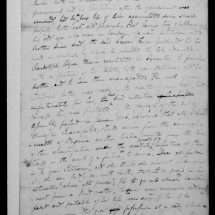
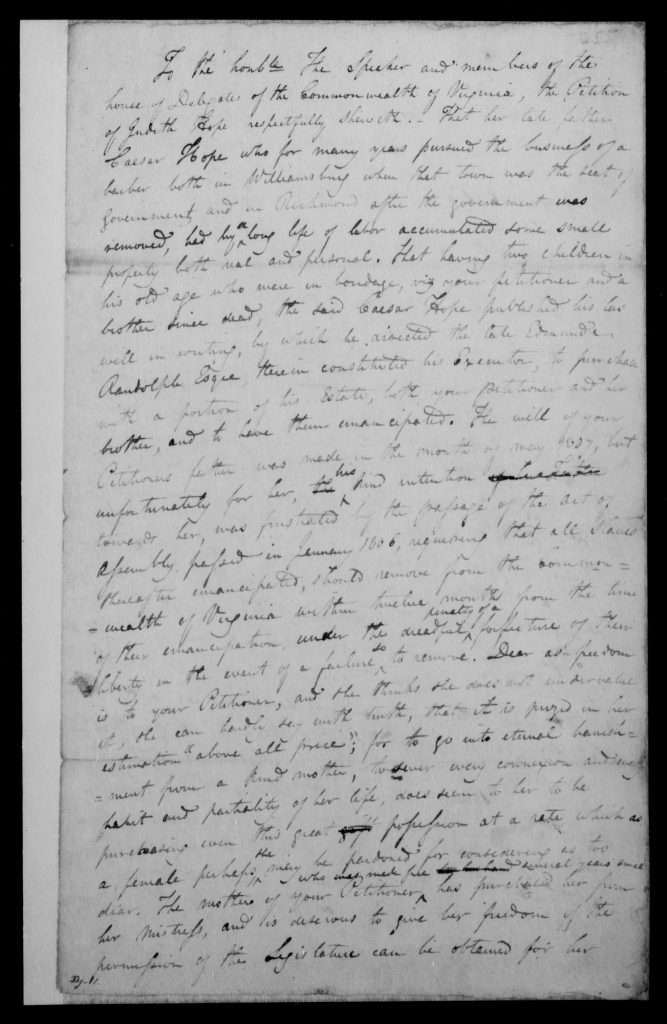
To the honble The Speaker and members of the house of Delegates of the Commonwealth of Virginia, the Petition of Judith Hope respectfully sheweth. That her late father Caesar Hope who for many years pursued the business of a barber both in Williamsburg when that town was the seat of government, and in Richmond after the government was removed, had by a long life of labor accumulated some small property both real and personal. That having two children in his old age who were in bondage, viz your petitioner and a brother since dead, the said Caesar Hope published his last will in writing, by which he directed the late Edmonde Randolph Esqu [Esquire], there in constituted his Executor, to purchase with a portion of his Estate, both your petitioner and her brother, and to have them emancipated. The will of your Petitioner further was made in the month of May 1807, but unfortunately for her, his kind intention towards her, was frustrated by the passage of the act of assembly, passed in January 1806, requiring that all slaves thereafter emancipated, should remove from the Commonwealth of Virginia within twelve months from the time of their emancipation, under the dreadful penalty of a forfieture of their liberty in the event of a failure so to remove. Dear as freedom is to your Petitioner, and she thinks she does not undervalue it, she can hardly say with the truth, that it is priced in her estimation “above all price”; for to go into eternal banishment from a kind mother, to sever every connexion and every habit and partiality of her life, does seem to her to be purchasing even this great possession at a rate which as a female perhaps she may be pardoned for considering as too diar. The mother of your Petitioner who was made free several years since has purchased her from her mistress, and is desirous to give her freedom if the permission of the Legislature can be obtained for her
— Page 2 —
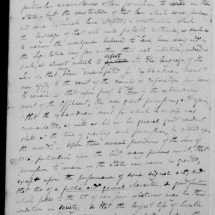
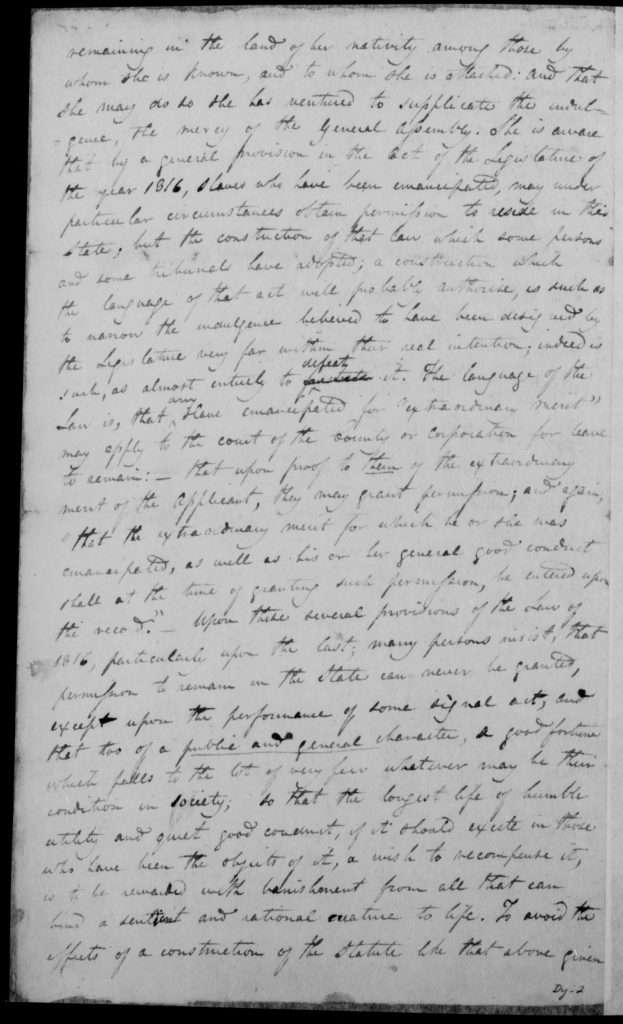
remaining in the land of her nativity among those by whom she is known, and to whom she is attached: And that she may do so she has ventured to supplicate the indulgence, the mercy of the General Assembly. She is aware that by a general provision in the Act of the Legislature of the year 1816, slaves who have been emancipated, may under particular circumstances obtain permission to reside in this state, but the construction of that law which some persons and some tribunals have adopted; a construction which the language of that act will probably authorise, is such as to narrow the indulgence believed to have been [illegible] by the Legislature very far within their real intention; indeed is such, as almost entirely to defeat it. The language of the Law is, that any slave emancipated for “extraordinary merit” may apply to the court of the county or corporation for leave to remain:—that upon proof to them of the extraordinary merit of the applicant, they may grant permission; and again; “that the extraordinary merit for which he or she was emancipated, as well as his or her general good conduct shall at the time of granting such permission, be entered upon the record.”— Upon these several provisions of the Law of 1816, particularly upon the last; many persons insist, that permission to remain in the state can never be granted, except upon the performance of some signal act, and that too of a public and general character, a good fortune which falls to the lot of very few whatever may be their condition in society; so that the longest life of humble utility and quiet good conduct, if it should excite in those who have been the objects of it, a wish to recompense it, is to be rewarded with banishment from all that can bind a sentient and rational creature to life. To avoid the effects of a construction of the statute like that above given
— Page 3 —
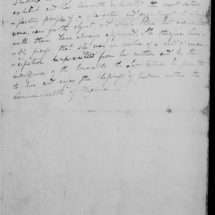
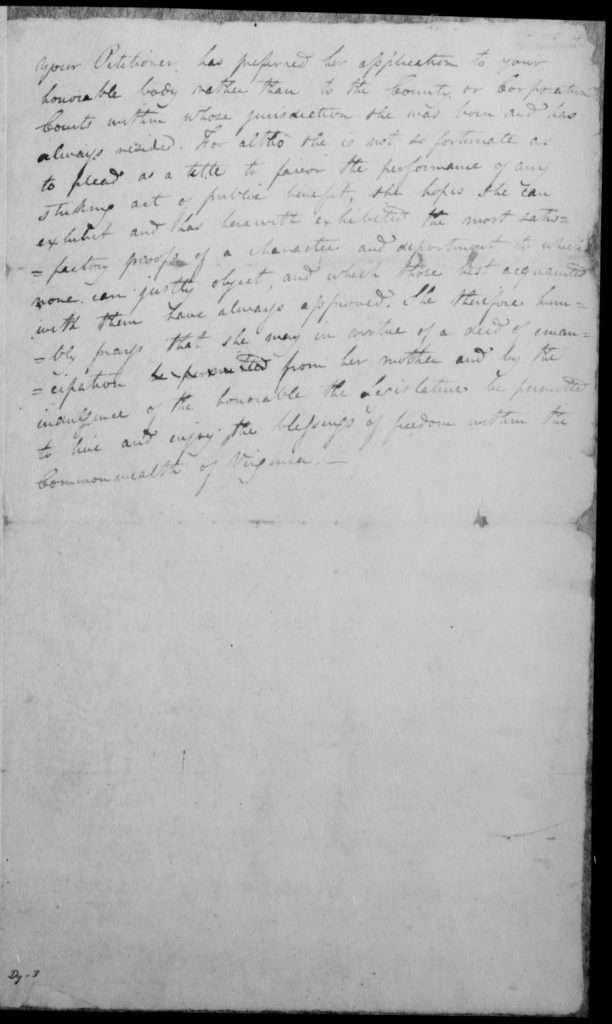
your Petitioner has prepared her application to your honorable body rather than to the County or Corporation Courts within whose jurisdiction she was born and has always resided. For altho she is not so fortunate as to plead as a title to favor the performance of any striking act of public benefit, she hopes she can exhibit and has herewith exhibited the most satisfactory proofs of a character and deportment to which none can justly object, and which those best acquainted with them have always approved. She therefore humbly prays that she may in virtue of a deed of emancipation from her mother and by the indulgence of the honorable the Legislature be permitted to live and enjoy the blessings of freedom within the Commonwealth of Virginia.


