


State of Pennsylvania
Wayne County
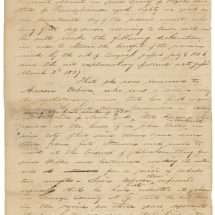
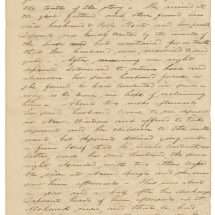
On this twentieth day of November AD 1837 personally appeared before the Court of Common Pleas of said county of Wayne Sarah Benjamin a resident of Pleasant Mount in said County of Wayne and State of Pennsylvania aged eighty one years on the seventeenth day of the present month, who being first duly sworn according to law doth on her oath make the following declaration in order to obtain the benefit of the provision made by the act of Congress passed July 4 1836, and the act explanatory of said act, passed March 30 1837:
That she was married to Aaron Osborn, who was a soldier during the revolutionary war, that her first acquaintance with the said Osborn commenced at Albany in the state of New York [insert] ^during the hard winter of 1780 [/insert], that deponent then resided at the house of one John Willis [insert] ^a blacksmith [/insert] in said city, that said Osborn came down there from fort Stanwix and went to work at the business of blacksmithing for said Willis and continued working at intervals [strikethrough] [illegible] [/strikethrough] for a period of perhaps two months – Said Osborn [insert] ^then [/insert] informed deponent that he had [insert] ^first [/insert] visited at Goshen in Orange County N.Y. that he had been in the service for three years, deponent thinks, about one year of that time at Fort-Stanwix and that his time was out – and, under an assurance that he would go to Goshen with her, she married him at the house of said Willis during the time he was there as above mentioned, [insert] ^to wit in January 1780 [/insert], that deponent was informed by said Osborn
— Page 2 —
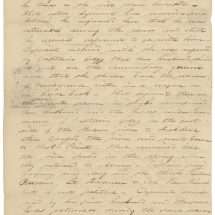
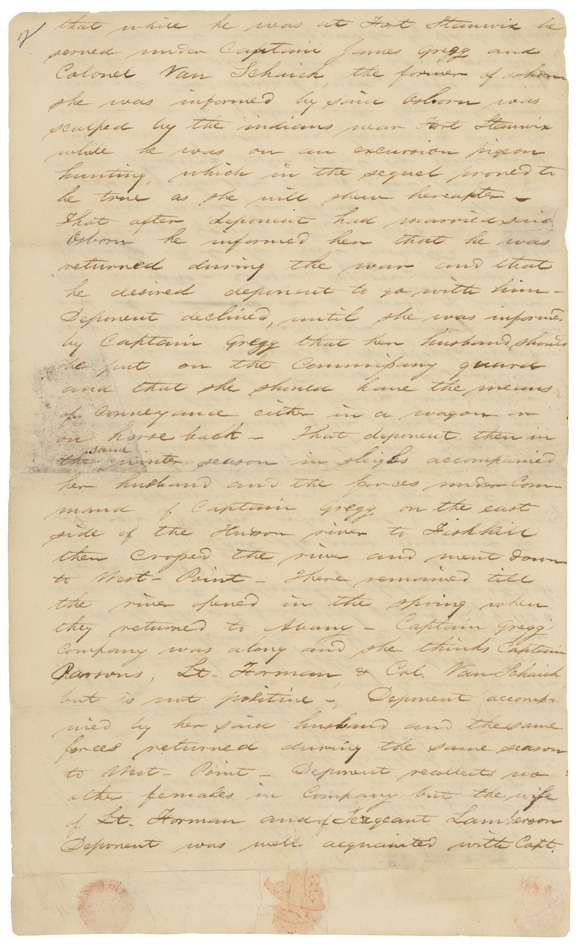
that while he was at Fort Stanwix he served under Captain James Gregg and Colonel Van Schaich the former of whom she was informed by said Osborn was scalped by the indians near Fort Stanwix while he was on an excursion pigeon hunting, which in the sequel proved to be true as she will show hereafter – that after deponent had married said Osborn he informed her that he was returned during the war and that he desired deponent to go with him – deponent declined, until she was informed by Captain Gregg that her husband should be put on the Commissary guard and that she should have the means of Conveyance either in a wagon or on horseback – that deponent then in the [insert] ^same [/insert] winter season in sleighs accompanied her husband and the forces under Command of Captain Gregg on the east side of the Hudson river to Fishkill then crossed the river and went down to West-Point – there remained till the river opened in the spring, when they returned to Albany – Captain Gregg’s company was along and she thinks Captain Parsons, Lt. Forman & Col. Van Schaich but is not positive – Deponent accompanied by her said husband and the same forces returned during the same season to West-Point – Deponent recollects no other females in Company but the wife of Lt. Forman and of Sergeant Lamberson Deponent was well acquainted with Capt.
— Page 3 —
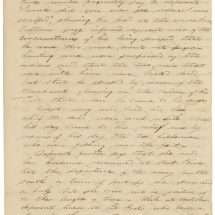
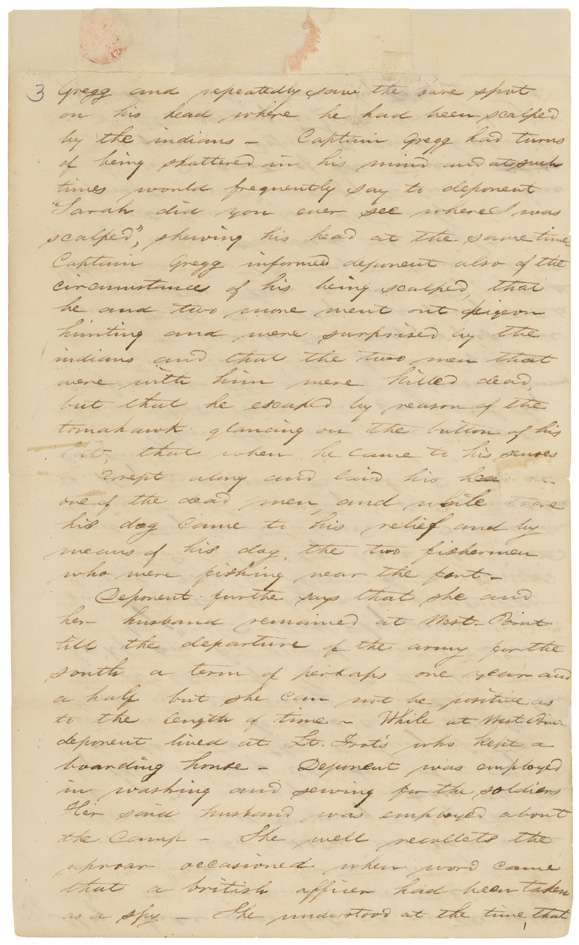
Gregg and repeatedly saw the same spot on his head where he had been scalped by the indians –Captain Gregg had turns of being shattered in his mind and at such times would frequently say to deponent “Sarah, did you ever see where I was scalped”, shewing his head at the same time, Captain Gregg informed deponent also of the circumstance of his being scalped, that he and two more went out pigeon hunting and were surprised by the indians and that the two men that were with him were killed dead, but that he escaped by reason of the tomahawk glancing on the button of his [illegible], that when he came to his senses [illegible] alongg and laid his [illegible] one of the dead men, and while there his dog came to his relief and by means of his dog, the two fishermen who were fishing near the port –
Deponent further says that she said her husband remained at West -oint till the departure of the army for the south a term of perhaps one year and a half but she can not be positive as to the length of time – While at West Point deponent lived at Lt. [illegible] who kept a boarding house – Deponent was employed in washing and serving for the soldiers Her said husband was employed about the Camp – She well recollects the uproar occasioned when word came that a british officer had been taken as a spy – She understood at the time that
— Page 4 —
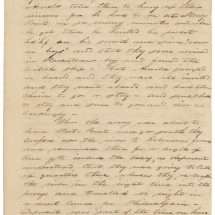
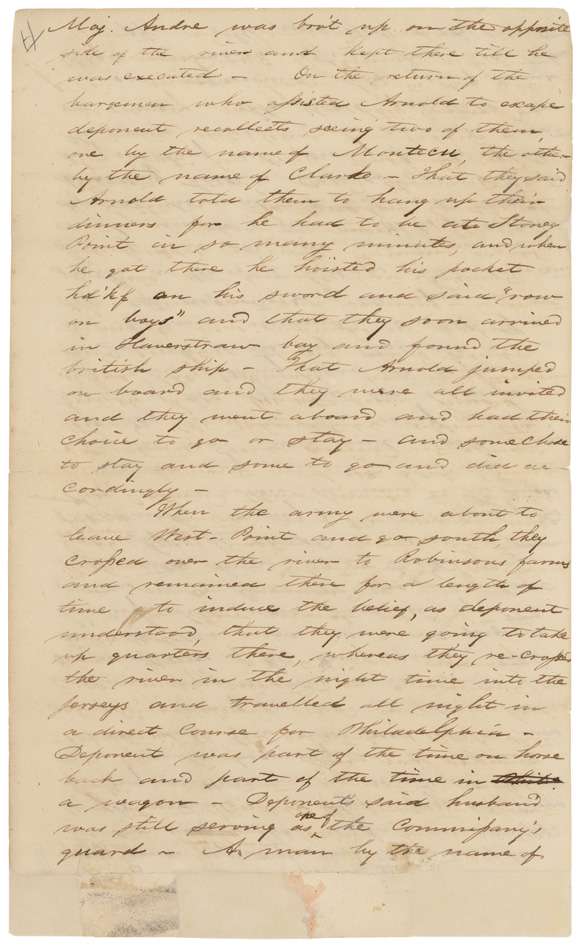
Maj. Andre was biv’t up on the opposite side of the river and kept there till he was executed – On the return of the bargemen who assisted Arnold to escape deponent recollects seeing two of them, one by the name of Montecu, the other by the name of Clarke – that they said Arnold told them to hang up their dinners for he had to be at Stoney Point in so many minutes, and when he got there he hoisted his pocket hd’kf on his sword and said “row on boys” and that they soon arrived in Haverstraw bay and found the british ship – That Arnold jumped on board and they were all invited and they went aboard and had their choice to go or stay – and some chose to stay and some to go and did accordingly –
When the army were about to leave West-Point and go south they crossed over the river to Robinsons farms and remained there for a length of time to induce the belief, as deponent understood, that they were going to take up quarters there, whereas they re-crossed the river in the night time into the Jerseys and travelled all night in a direct course for Philadelphia – Deponent was part of the time on horse back and part of the time in a wagon – Deponent’s said husband was still serving as [insert] ^one of [/insert] the Commissary’s guard – A man by the name of
— Page 5 —
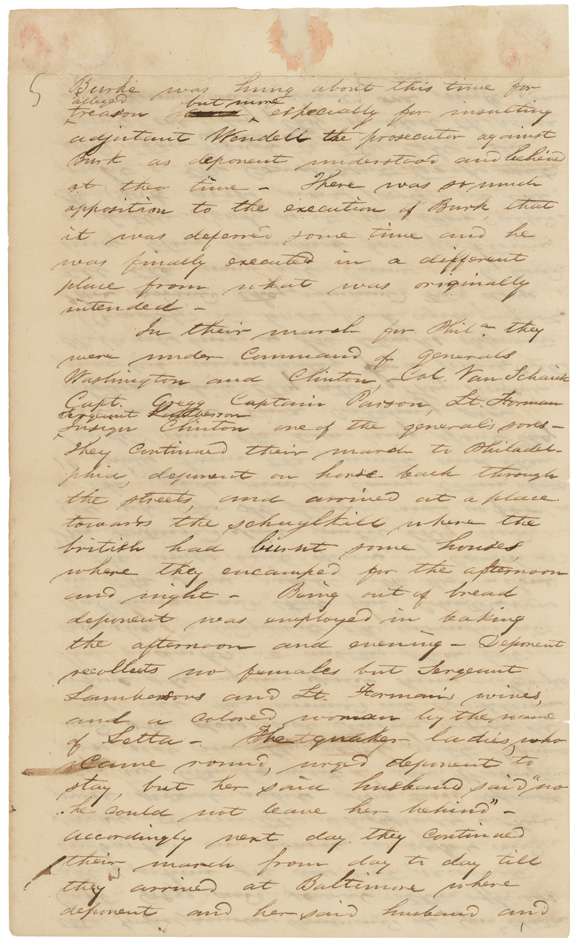
Burke was hung about this time for [insert] ^alleged [/insert] treason [insert] ^but more [/insert] especially for insulting adjutant Wendell the prosecutor against Burk as deponent understood and believe at the time – There was so much opposition to the execution of Burk that it was deferred some time and he was finally executed in a different place from what was originally intended –
In their march for Phila they were under Command of Generals Washington and Clinton, Col. Van Schaik, Capt. Gregg, Captain Parson, Lt. Forman, [insert] ^Sergeant Lamberson [/insert], Ensign Clinton, one of the general’s sons – They continued their march to Philadelphia, deponent on horse back through the streets, and arrived at a place towards the Schuylkill where the british had burnt some houses, where they encamped for the afternoon and night – Being out of bread deponent was employed in baking the afternoon and evening – Deponent recollects no females but Sergeant Lambersons and Lt Forman’s wives, and a colored woman by the name of Letta – The quaker ladies, who came round, urged deponent to stay, but her husband said “no he could not leave her behind” – Accordingly next day they continued their march from day to day till they arrived at Baltimore where deponent and her said husband and

— Page 6 —
the forces under Command of Gen’l Clinton, Capt. Gregg and several other officers all of whom she does not recollect embarked on board a vessel and sailed down the Chesapeake – There were several vessels along and deponent was in the foremost – Gen’l Washington was not in the vessel with deponent and she does not know where he was till he arrived at Yorktown where she again saw him – He might have embarked at another place, but deponent is confident she embarked at Baltimore and that Gen’l Clinton was in the same vessel with her – Some of the troops went down by land – They continued sail until they had got up the St. James river as far as the tide would carry them, about 12 miles from the mouth and then landed and the tide being spent, they had a fine time catching sea lobsters which they ate – They however marched immediately for a place called Williamsburg, as she thinks deponent alternately on horse back and on foot; There arrived, they remained two days till the army all came in by land – and then marched for Yorktown, or Little York as it was then called – The York troops were posted at the right – the Connecticut troops next and the French to the left – In about one day [insert] ^or less than a day [/insert] they reached the place of encampment about one mile from
— Page 7 —
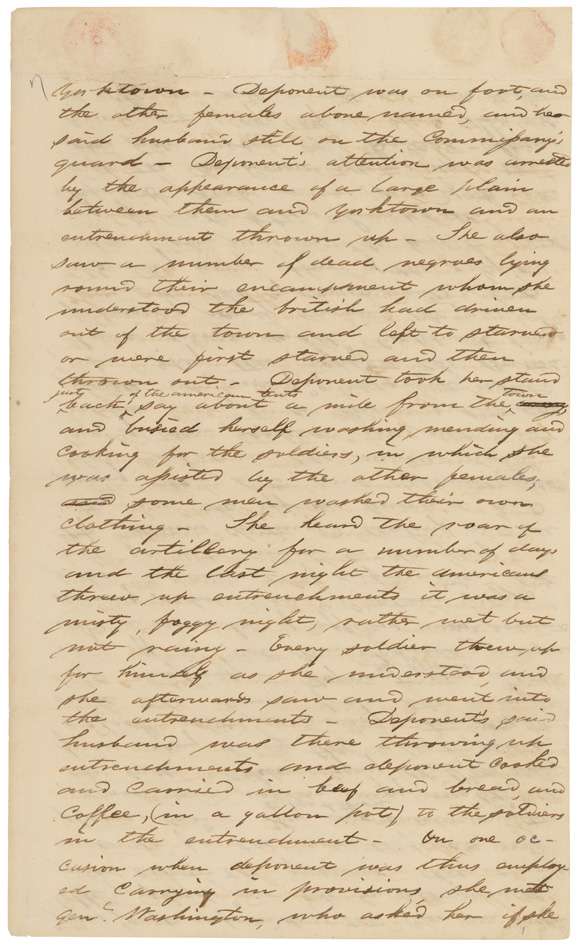
Yorktown – Deponent was on foot, and the other females above named, and her said husband still on the Commissary’s guard – Deponent’s attention was [illegible] by the appearance of a large plain between them and Yorktown and an entrenchment thrown up – She also saw a number of dead negroes lying round their encampment whom she understood the british had driven out of the town and left to starve or were first starved and then thrown out – Deponent took her stand [insert] ^just [/insert] back [insert] ^of the american tents [/insert] say about a mile from the [insert] ^town [/insert] and busied herself washing, mending and cooking for the soldiers, in which she was assisted by the other females, some men washed their own clothing – She heard the roar of the artillery for a number of days and the last night the americans threw up entrenchments it was a misty, foggy night, rather wet but not rainy – Every soldier threw up for himself as she understood and she afterwards saw and went into the entrenchments – Deponent’s said husband was there throwing up entrenchments and deponent cooked and carried in beef and bread, and coffee, (in a gallon pot) to the soldiers in the entrenchment – On one occasion when deponent was thus employed carrying in provisions, she met Gen’l Washington, who asked her if she

— Page 8 —
“was not afraid of the Cannon balls” She replied “no, the bullets would not cheat the gallows – that it would not do for the men to fight and starve too” – They dug entrenchments nearer and nearer [insert] ^to Yorktown [/insert] every night [insert] ^or two [/insert] till the last – While digging that, the enemy fired very heavy till about nine o clock next morning – then stopped – and the drums from the enemy beat excessively – Deponent was a little way off in Col Van Schaick’s [insert] ^or the officers’ [/insert] marque and a number of officers were present among whom was Captain Gregg, who, on account of infirmities did not go out much to do duty – the drums continued beating, and all at once the officers hurried and swung their hats, and deponent asked them “what is the matter now” – One of them replied “are not you soldier enough to know what it means”, deponent replied “no” – They then replied “the British have surrendered” Deponent, having provisions ready, carried the same down to the entrenchments that morning and four of the soldiers whom she was in the habit of cooking for ate their breakfasts – Deponent stood on one side of the road and the american officers upon the other side, when the British officers came out of the town and rode up to the american officers and deliv –

— Page 9 —
[missing text] thinks were returned again, and the British officers rode right on before the army who marched out beating [insert] ^and playing [/insert] a melancholy tune, their drums covered with black hdkfs and their pipes with black ribbands tied around them – into an old field and there grounded their arms and then returned into town again to await their destiny – Deponent recollects seeing a great many american officers some on horse back and some on foot, but can not call them all by name – Washington, LaFayette and Clinton were among the number – The British general at the head of the army was a large portly man, full face, and the tears rolled down his cheeks as he passed along – She does not recollect his name – But it was not Cornwallis – She saw the [illegible] afterwards and noticed his being a man of diminutive appearance and having cross eyes – On going into town she noticed two dead negroes lying by the musket house – She had the curiosity to go into a large building that stood near by – and there she noticed the cupboards smashed to pieces and china dishes and other wares strewn around upon the floor and among the rest a pewter cover to a hot basin that had a handle on it –
— Page 10 —
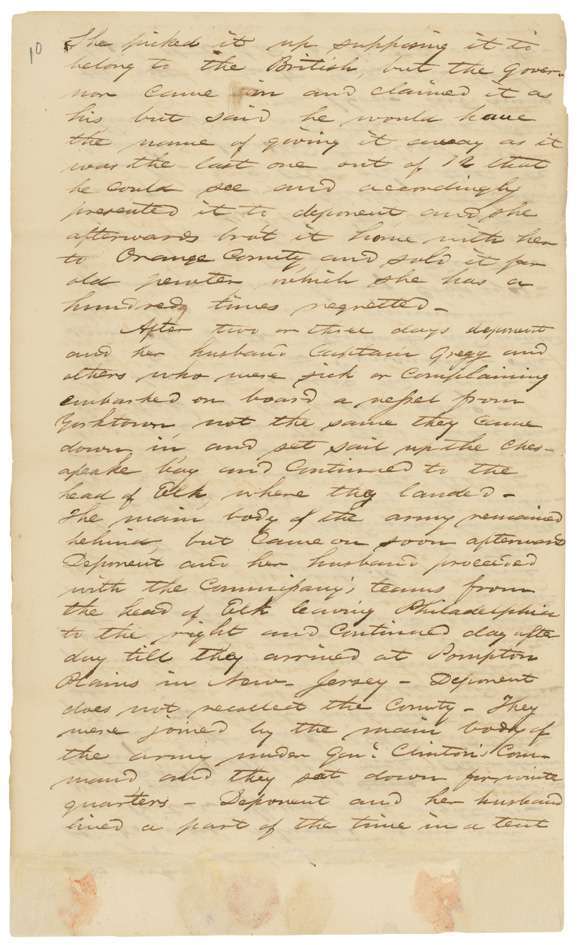
She picked it up supposing it to belong to the British, but the governor came in and claimed it as his, but said he would have the name of giving it away as it was the last one out of 12 that he could see and accordingly presented it to deponent, and she afterwards brot it home with her to Orange County, and sold it for old pewter, which she has a hundred times regretted –
After two or three days deponent and her husband Captain Gregg and others who were sick or complaining embarked on board a vessel from Yorktown, not the same they came down in, and set sail up the Chesapeake bay and continued to the head of the Elk, where they landed – The main body of the army remained behind, but came on soon afterwards Deponent and her husband proceeded with the Company’s teams from the head of Elk Leaving Philadelphia to the night and continued day after day till they arrived at Pompton Plains in New Jersey – Deponent does not recollect the County – They were joined by the main body of the army under Gen’l Clinton’s Command and they sat down for winter quarters – Deponent and her husband lived a part of the time in a tent
— Page 11 —
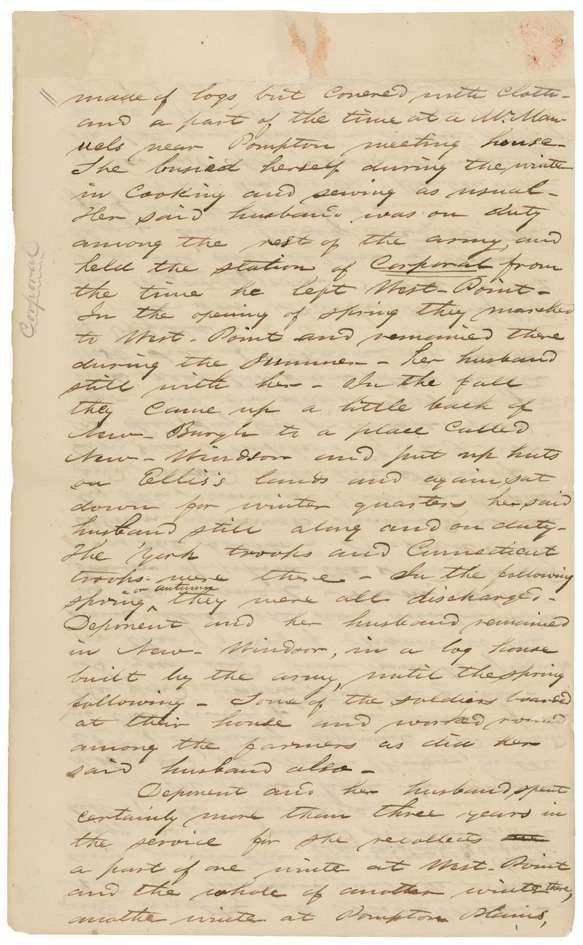
made of logs, but covered with cloth – and a part of the time at a Mr. Maumals near Pompton meeting house – She busied herself during the winter in cooking and serving as usual – Her said husband was on duty among the rest of the army, and held the station of Corporal from the time he left West-Point – In the opening of spring they marched to West-Point and remained there during the summer – her husband still with her – In the fall they came up a little back of New-Burgh to a place called New-Windsor and put up huts on Ellis’s lands and again sat down for winter quarters, her said husband still along and on duty – The York troops and Connecticut troops were there – In the following spring [insert] ^or autumn [/insert] they were all discharged – Deponent and her husband remained in New-Windsor, in a log house built by the army, until the spring following – Some of the soldiers boarded at their house and worked round among the farmers as did her said husband also –
Deponent and her husband spent certainly more than three years in the service for she recollects a part of one winter at West-Point and the whole of another winter there, another winter at Pompton Plains,

— Page 12 —
and another at New-Windsor – And her husband was the whole time under the command of Capt. Gregg as an enlisted soldier [insert] ^holding the station of Corporal [/insert] to the best of her knowledge –
In the winter before the army were disbanded, at New-Windsor, on the 20th of February, deponent had a child by the name of Phebe Osborn of whom the said Aaron [insert] ^Osborne [/insert] was the father – A year and five months afterward on the 9th day of August at the same place she had another child by the name of Aaron Osborn Junior of whom the said husband was the father – The said Phebe Osborn afterwards married a man by the name of William Ruckwell and moved into the Town of Dryden, Tompkins Co. N.Y. where he died, say ten or twelve years ago, but the said daughter – yet lives near the same place on the west side of Ithaca in the town of Enfield –
Her son Aaron Osborn Jr. lived in Blooming grove Orange Co. N.Y. had pets [insert] ^and was crazy [/insert] and became a town charge and finally died [insert] ^there [/insert] at the age of about 20 years –
About three months after the birth of her last child, Aaron Osborn Junior, she last saw her said husband who [insert] ^then [/insert] left her at New-Windsor and never returned. He had been absent at intervals before this
— Page 13 —
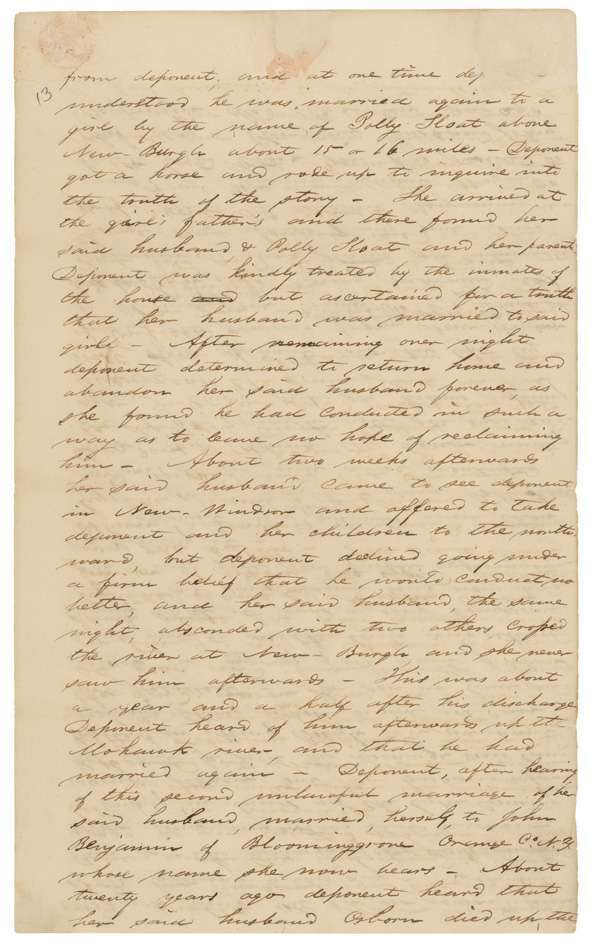
from deponent; and at one time dep[onent] understood he was married again to a girl by the name of Polly Sloat above New-Burgh about 15 or 16 miles – Deponent got a horse and rode up to inquire into the truth of the story – She arrived at the girl’s father’s and there found her said husband, & Polly Sloat and her parents Deponent was kindly treated by the inmates of the house but ascertained for a truth that her husband was married to said girl – After remaining over night deponent determined to return home and abandon her said husband forever, as she found he had conducted in such a way as to leave no hope of reclaiming him – About two weeks afterwards her said husband came to see deponent in New-Windsor and offered to take deponent and her children to the northward, but deponent declined going under a firm belief that he would conduct no better, and her said husband, the same night, absconded with two others, crossed the river at New-Burgh, and she never saw him afterwards – This was about a year and a half after his discharge. Deponent heard of him afterwards up the Mohawk river, and that he had married again – Deponent, after hearing of this second unlawful marriage of her said husband married, herself, to John Benjamin of Blooming grove Orange Co. N.Y. whose name she now bears – About twenty years ago deponent heard that her said husband Osborn died up the


