

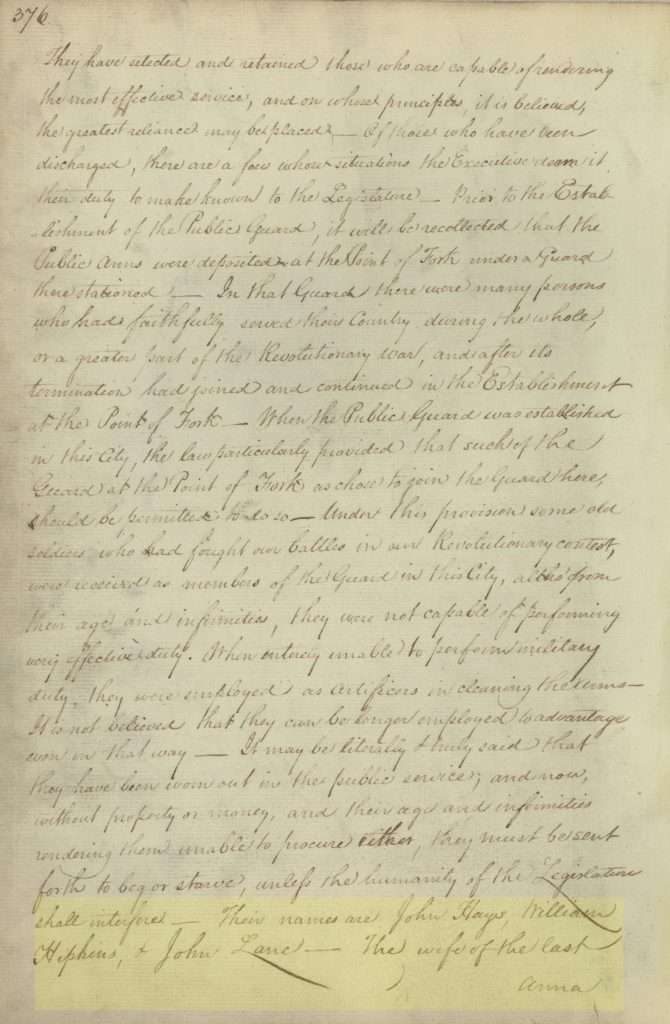
They have selected and retained those who are capable of rendering the most effective service, and on whose principles, it is believed, the greatest reliance may be placed,—Of those who have been discharged, there are a few whose situations the Executive deem it their duty to make known to the Legislature—Prior to the Establishment of the Public Guard, it will be recollected that the Public arms were deposited at the Point of Fork under a Guard there stationed—In that Guard there were many persons who had faithfully served their Country during the whole, or a greater part of the Revolutionary War, and after its termination had joined and continued in the Establishment of the Point of Fork—When the Public Guard was established in this City, the law particularly provided that such of the Guard at the Point of Fork as chose to join the Guard here, should be permitted to do so—Under this provision some old soldiers who had fought our battles in the Revolutionary contest, were received as members of the Guard in this City, altho’ from their age and infirmities, they were not capable of performing very effective duty. When entirely unable to perform military duty, they were employed as artificers in cleaning the arms—It is not believed that they can be longer employed to advantage now in that way—It may be literally & truly said that they have been worn out in the public service; and now, without property or money, and their age and infirmities rendering them unable to procure either, they must be sent forth to beg or starve, unless the humanity of the Legislature shall interfere—Their names are John Hays, William Hipkins, & John Lane—The wife of the last
—Page 2—
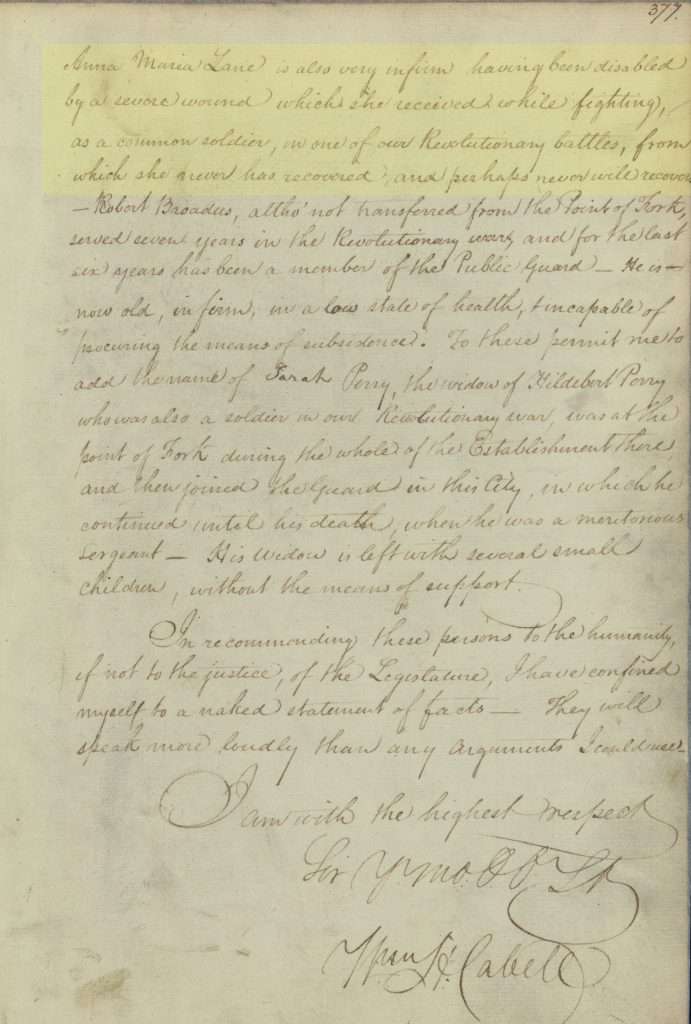
Anna Maria Lane is also very infirm having been disabled by a severe wound which she received while fighting, as a common soldier, in one of our Revolutionary battles, from which she never has recovered, and perhaps never will recover.—Robert Broadeus, altho’ not transferred from the Point of Fork, served seven years in the Revolutionary war, and for the last six years has been a member of the Public Guard—He is now old, infirm, in a low state of health, & incapable of procuring the means of subsistence. To these permit me to add the name of Sarah Perry, the widow of Hildebert Perry who was also a soldier in our Revolutionary war, was at the point of Fork during the whole of the Establishment there, and then joined the Guard in this City, in which he continued until his death, when he was a meritorious Sergeant—His widow is left with several small children, without the means of support.
In recommending these persons to the humanity, if not to the justice, of the Legislature, I have confined myself to a naked statement of facts—They will speak more loudly than any arguments I could use.
I am with the highest respect
Sir Yr mo: Obt St
WM H. Cabell


