


Background

Race was used as a tool of housing discrimination in Charlottesville since at least 1893, when racial covenants barred Black residents from owning homes or living in the Locust Grove neighborhood. In 1912, the Charlottesville City Council passed a citywide racial segregation ordinance, but this became inoperative after a similar law in Louisville, Kentucky, was ruled unconstitutional by the Supreme Court in 1917. However, local property owners and developers continued to use racial covenants in private deeds to restrict Black homeownership, and the subsequent wealth those properties generated. In 1948 the U.S. Supreme Court found that racial covenants could not be enforced and the 1968 federal Fair Housing Act made them illegal. This greatly restricted where Black residents were able to live, forcing many to rent from white landlords in Black sections of the city. Many of these landlords did not maintain their properties and the city often denied these areas basic public services, making it easier to declare these areas “slums” when federal urban renewal efforts began. Nevertheless, in 1933, in the depths of the Great Depression, 48.2 percent of Charlottesville’s Black residents were homeowners.
Creating the CRHA

On December 19, 1949, following passage of the Housing Act of 1949, which provided authority and funding for cities to clear largely Black neighborhoods designated as “slums,” Charlottesville mayor Gus Tebell created a ten-person committee to “study slum clearance and federal housing.” The committee included two Black businessmen and eight white real estate brokers, developers, businessmen, and city council members. The committee asked the Joint Health Department to study areas in the city that were considered “blighted.” The study, completed in 1951, looked at seventy-seven square blocks in the Vinegar Hill, Starr Hill, and 10th & Page neighborhoods, where Black residents made up 84.2 percent of the 3,767 residents. Of the 1,345 homes studied, the Joint Health Department determined that 577 were “real slums” and of such low quality that “demolition is the only practicable remedy.” Dr. S. D. Sturkle, the director of the Joint Health Department, compared the blighted properties to “a cancerous growth” and warned that, if left untreated, the blight could “spread first from house to house, then from block to block and finally from neighborhood to neighborhood,” repeating the common refrain that blight posed a threat to the property values of white homeowners.
The report recommended that the city council amend the city code to give it the legal authority to condemn housing it deemed substandard. It further stated that “new low rental housing” should be created to replace the demolished units.
The federal Housing Act of 1949 and its subsequent 1954 modification gave cities new authority to acquire blighted land through eminent domain and condemnation proceedings. It also provided cities with funding to buy large swaths of this land and allowed them to resell it to private residential, commercial, and industrial developers rather than use it for public purposes.

In 1954 a citywide referendum was held to decide whether to create the Charlottesville Redevelopment and Housing Authority, which was a requirement for a municipality to receive federal urban renewal funding. The creation of the CRHA had been debated for five years. Many Black residents supported the creation of public housing to improve the quality of housing for Vinegar Hill residents who rented from negligent white landlords. But they opposed urban renewal because it meant the destruction of Black communities and many Black-owned businesses. Many white residents also opposed urban renewal because they asserted that using public funds to create low-income housing was akin to socialism, which they opposed. They also feared that the creation of public housing would potentially speed the process of residential and school desegregation, which many also opposed. The CRHA referendum passed by just 36 votes—1,105 to 1,069—at a time when a poll tax was required to register to vote, which greatly reduced turnout among low-income voters. Mayor William R. Hill named five white men to the CRHA—a contractor, a professor, a banker, an attorney, and a military parts executive—instructing them to find ways to clear “blighted areas in the city” and create low-income housing.
The Master Plan

In 1956 Charlottesville hired the St. Louis-based urban planning firm of Harland Bartholomew and Associates to create a twenty-five-year master plan to guide the city’s growth. The firm’s founder, Harland Bartholomew, was a nationally known urban planner who championed racially restrictive practices that targeted Black neighborhoods and prioritized building roads to speed access to the growing, mostly white suburbs. The 1957 master plan drew from the findings of the 1950 Joint Health Department study as well as a series of newly conducted housing surveys that assessed a building’s structure, quality, utilities, and proximity to resources. The plan recommended the destruction of five majority-Black neighborhoods: Vinegar Hill, Cox’s Row, Garrett Street, Gospel Hill, Kellytown, and part of Fifeville. It also recommended that the city develop a “minimum-standard housing ordinance” and implement “public housing and urban renewal.”
Vinegar Hill

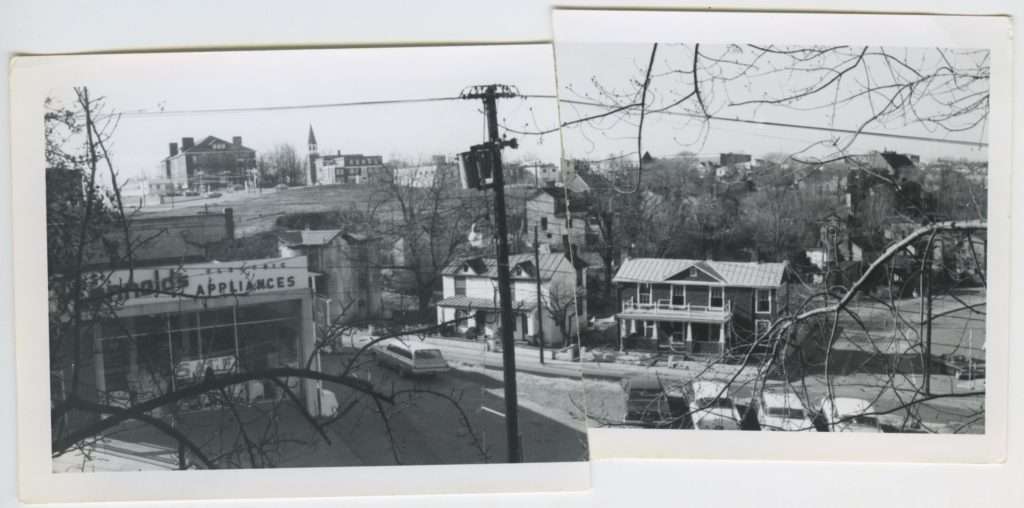
Vinegar Hill was the first target of urban renewal. Black residents had begun buying property in Vinegar Hill as early as 1870. By the 1890s, in addition to dozens of residences it was home to the Jefferson Graded School, Inge’s Grocery Store, the Mentor Lodge No. 1453 Grand United Order of Odd Fellows, and the Piedmont Industrial and Land Improvement Company, a member-based real estate development company aimed at increasing Black homeownership. By the early twentieth century, Black entrepreneurs had created a thriving business district along West Main Street. Jefferson High School was constructed one block away in 1926 as one of Virginia’s six accredited Black high schools. There were six Black churches in the area, as well as Black benevolent societies and mutual aid organizations and Black physician and dentist offices. The area continued to grow throughout the twentieth century, becoming a vibrant cultural and economic hub for Black residents. By 1959, the twenty-nine businesses in the part of Vinegar Hill targeted for urban renewal had a gross income of $1.6 million and included restaurants, grocery stores, barbershops, and a variety of retail stores.

The Black businesses on West Main Street were adjacent to the white businesses in downtown Charlottesville on East Main Street. These white business owners feared that a new shopping center slated to open two miles away in Albemarle County, which was projected to have $8 to $10 million in annual sales, would hurt them economically. “There is little doubt that the longer redevelopment of Vinegar Hill is delayed, the more opportunity [there is] for expanding outlying shopping and business centers at the expense of downtown Charlottesville,” wrote Lorin A. Thompson, director of the University of Virginia’s Bureau of Population Economic Research, who was hired by the local government to prepare a marketability and land use analysis of the city. Thompson, who also served on the city’s planning commission, estimated that the city could increase the annual business revenue derived from the area to between $7.5 and $9.4 million by demolishing Vinegar Hill. But when a Black resident proposed building new public housing in the cleared area of Vinegar Hill, the head of the CRHA made it clear that Vinegar Hill would be redeveloped “to allow a westward expansion of the downtown business district.”
Maps of Vinegar Hill


In 1958, the federal Housing and Home Finance Agency approved CRHA’s $39,673 slum clearance planning proposal for Vinegar Hill. The redevelopment authority also received a $35,000 loan from the federal Public Housing Authority to draw up plans for 200 public housing units, some of which were intended for low-income, displaced Vinegar Hill residents. At the time, the estimated cost for the Vinegar Hill project was almost $2.3 million, with the resale of the land expected to net about $1.9 million. The total cost eventually grew to nearly $2.6 million, while the expected proceeds from the sale of land shrank to $1.4 million. Federal funds were expected to pay for 75 percent of the project’s costs.


In 1960, the CRHA hired James M. Marshall, a local white realtor, to conduct a parcel-by-parcel appraisal of Vinegar Hill. He found that Vinegar Hill had 463 Black residents, and 44 white residents, and an estimated market value of $1.8 million. There were thirty-five Black-owned homes in the neighborhood, which, Marshall wrote, “are the best residential buildings in the area.” Many of the poorly maintained properties, some of which lacked indoor plumbing or proper insulation, were owned by the estate of William Dandridge Haden, a white man who had been Charlottesville’s mayor, a member of the city council, and president of the National Bank and Trust Company and had served on the University of Virginia’s Board of Visitors. Housing options for Black residents in Charlottesville were drastically limited, Marshall noted, because of a lack of “financing on one hand and reluctance to sell to colored on the part of the people in white neighborhoods.” That same year, Mayor Thomas J. Michie said, “There is nowhere else for them to go, much as they would like to. If you doubt it, ask any real estate man to find you any vacant Negro housing in Charlottesville.”
Public Housing
In 1959, the CRHA identified two tentative sites for 200 units of public housing designated for Black people and two sites for twenty-five units designated for white people. George Wilkins Price Jr., executive director of the CRHA, noted that private property might be taken to construct this new housing. White opponents of public housing, who feared the proposed projects could lower property values and lead to school desegregation, pressed the city council for a citywide referendum. Fearing their demands would be ignored, Virginia state senator Edward O. McCue Jr. introduced a bill that would allow residents who collected 100 signatures to force a referendum in any Charlottesville ward where public housing was proposed. The Charlottesville-Albemarle Tribune, the local Black newspaper, called the bill “a masterpiece of discrimination” that “would permit one small segment of our local citizens to thwart the wishes of the City as a whole.” Mayor Thomas J. Michie and CRHA director Price also opposed the measure, saying it would effectively kill any urban renewal project in the city.
McCue’s bill became law in 1959. That same year, CRHA chair Edward R. Slaughter apologized for forcing public housing onto Charlottesville residents, saying, “I don’t believe any one of us is enthusiastic about public housing. But it’s the only way we know to accomplish the Vinegar Hill project. It’s the urban renewal part we’re enthusiastic about.” Meanwhile, the CRHA completed an eligibility and relocation report for the Urban Renewal Administration, the federal agency that would finance the Vinegar Hill project if it was able to show the area was “blighted.”
The 1960 Referendum
The referendum to allow the Vinegar Hill urban renewal project and the creation of public housing for Black residents to proceed was endorsed by local white leaders and groups, including the Chamber of Commerce, the Retail Merchants Association, the League of Women Voters, twenty-four local architects, and the presidents of three area banks. By this time, the CRHA had abandoned plans to build public housing for low-income white residents, opting instead to subsidize their rents in the existing private housing market.
In June 1960, with the poll tax still in effect, voters narrowly approved the referendum by 23 votes—1,831 to 1,808. Shortly thereafter, the city council approved the final Vinegar Hill urban renewal plan, agreeing to contribute $400,000 worth of land, street construction, and utility installation. Black business owners in Vinegar Hill requested financial assistance to relocate, but CRHA attorney David J. Wood Jr. said the agency was prohibited from discriminating based on race and that “no special provision could be made to relocate Negro businesses in the redevelopment area.”
Cox’s Row and Westhaven


In 1961, the federal Public Housing Authority approved Cox’s Row, a working-class neighborhood that was 95 percent Black, as a potential site for Black public housing. There were thirty-four owner-occupied and rental homes in the Cox’s Row area. Many white residents favored the Cox’s Row site because it would keep existing residential and school segregation intact. Black leaders, however, objected to the site. Eugene Williams, president of the Charlottesville National Association for the Advancement of Colored People (NAACP), said the area’s low-lying topography and its proximity to the city’s storage yard, a railroad line, and the polluted Schenks Branch creek were health hazards. The Charlottesville Crusade for Voters, a Black civic organization, requested that the city council appoint a Black member to the CRHA, but their request was ignored. The Charlottesville NAACP, which had implemented effective community organizing strategies, was largely focused at the time on fighting Massive Resistance. NAACP members waged sit-ins at segregated businesses and protested racially restrictive white neighborhoods, but the fight for anti-displacement approaches to the redevelopment of Vinegar Hill was unsuccessful. By a vote of 2,483 to 799, residents authorized Charlottesville’s first urban renewal project by approving public housing to be built at Cox’s Row.
In 1963, the CRHA began construction of a new ten-acre, 126-unit public housing project called Westhaven. It was named after John West, who was born enslaved, became a major property owner in the area, and was elected Charlottesville’s first Black alderman in 1881. He had raised his family in Vinegar Hill.
The End of Vinegar Hill
Destruction of Vinegar Hill


In 1962, the CRHA began purchasing 150 properties in Vinegar Hill under eminent domain. Homeowners were paid market value for their properties. Vinegar Hill renters said they did not receive the relocation payments promised by the CRHA. In early 1964, bulldozers and wrecking cranes began demolishing homes, businesses, and the Zion Union Baptist Church. After the neighborhood was leveled, the city constructed the four-lane Ridge McIntire Road through the area to carry traffic to the downtown business district and consolidated the 150 properties into eight large lots. The city created renderings of a large hotel and convention center proposed for the area and published promotional materials to attract developers. The CRHA began accepting bids for the land in 1968. In 1970, Citizens Commonwealth Corp. purchased 60,000 square feet of Vinegar Hill to build a six-story office building that was projected to bring the city $12,000 in tax revenue. Later that year, the CRHA sold another portion of Vinegar Hill to a car dealer for a parking lot. Citizens Commonwealth Corp. bought much of the remaining land, only to sell it back to the city after development plans fell through. By the 1980s, the city had resold most of the land, which was ultimately developed into a grocery store, a federal courthouse, and a taxpayer-funded hotel. Today, 31 percent of the original Vinegar Hill neighborhood is asphalt parking lots.
Garrett Street

In 1966, city officials proposed an urban renewal project for the Garrett Street neighborhood, a forty-acre area two blocks south of downtown that was home to 170 Black families and several dozen white families—more than 500 people total. An appraiser, again with an eye toward increasing the city’s tax base, described the neighborhood as a mix of owner-occupied and rental homes in “generally depressed economic conditions” and assessed the neighborhood’s value at $2.13 million. In 1967, the city held a referendum on three potential public housing sites for displaced Garrett Street residents, including one in the Garrett Street neighborhood, that provoked a fierce campaign for and against the expansion of public housing in Charlottesville. The Charlottesville NAACP opposed the construction of additional public housing that would “perpetuate segregation,” while white civic and business groups extolled the virtue of the additional “slum clearance” that the new public housing would allow. The referendum passed, with Black voters opposing the expansion of segregated public housing.

In 1973, having received federal approval, the city bulldozed 184 buildings in the neighborhood. Four years later, the land was sold for $205,103.60 to the Cavalier Development Corp., which constructed 150 apartments and townhomes for low-income residents eligible for federal subsidized housing vouchers. The first residents moved into Garrett Square in 1978. This would be the last urban renewal project in Charlottesville.
Gospel Hill
Gospel Hill and UVA Medical Center


The CRHA attempted to secure urban renewal funding in 1969 to raze the Gospel Hill neighborhood, which was home to approximately twenty-five working-class Black families and had a long history as a Black community. In 1869 George Walker became the first Black resident to buy land in Gospel Hill post-Emancipation. In 1885 Anthony T. Buckner, who had been born into slavery, opened a grocery store on West Main Street in Gospel Hill that he operated for thirty-eight years as a community staple, serving residents from the surrounding neighborhoods of 10th & Page, Fifeville, and Gospel Hill.
The neighborhood was across the street from the University of Virginia hospital, which was seeking to expand its footprint. The plan was to make the property available for the university to purchase, but the U.S. Department of Housing and Urban Development rejected the proposal, which caused the city council to withdraw its support. Despite the lack of federal urban renewal funding, the University of Virginia used a series of private land purchases to raze the Gospel Hill neighborhood and expand in the neighborhood, constructing academic buildings and University Hospital.
The Legacy of Urban Renewal

In total, urban renewal projects displaced more than 1,000 mainly Black residents from the Vinegar Hill, Cox’s Row, and Garrett Street neighborhoods. By 2020, the homeownership rate among Black residents of Charlottesville was 44.1 percent compared to 48.2 percent in 1933. In 2011, the City of Charlottesville officially apologized for the destruction of Vinegar Hill and Garrett Street, noting that “some residents of Charlottesville still feel the negative consequences of Urban Renewal and continue to distrust the City government as a result.”


