


Background

Parliament’s approval in 1767 of new duties on various goods imported by the North American colonies prompted immediate protests from the many colonists who hoped the repeal of the Stamp Act (1765) had signaled the end of British attempts to tax the colonies. From New England to Philadelphia, collective associations organized the kind of commercial boycotts and support for local manufacturers that had been so successful in bringing about the repeal of the stamp tax in 1766. In Virginia, Arthur Lee published his “Monitor’s letters” advocating commercial resistance to defend the constitutional liberties of the colonies; but the House of Burgesses in the spring of 1768 was content to send petitions to the King and Parliament and entertained no formal discussion of a commercial association.
An association in Virginia or Maryland could only be effective if it took into consideration the unique commercial structure of the Chesapeake Bay area. British trade with the region was the most valuable in the North American colonies and more Virginians participated directly in British trade than did residents of any other colony. At the same time, Virginians relied more heavily on British merchants to buy their agricultural products, and the lack of domestic manufactures made great planters and small farmers alike far more dependent on imported goods than were residents in northern colonies.

In the spring of 1769, George Mason and George Washington privately collaborated on a nonimportation plan that recognized the unique trading conditions of Virginia. They proposed a ban on imports that would apply to luxury goods and basic commodities above a designated price. In contrast to the associations in the northern colonies, they exempted the inexpensive cloth with which many planters provisioned enslaved laborers. The details of the plan were probably written by Mason. Washington, in his most important political leadership role yet, carried the proposal to a meeting of the House of Burgesses in Williamsburg in May 1769. Washington was among the first to argue that any commercial association should promote long-term changes in the Virginia economy to make the colony less dependent on the export of tobacco and the import of British goods.
On May 17, Governor Norborne Berkeley, baron de Botetourt, dissolved the assembly in retaliation for its several resolutions denouncing recent parliamentary restrictions on the right to trial by jury and the duties on imports. Afterward, most of the burgesses gathered at the nearby Raleigh Tavern and approved a nonimportation association with only a few revisions of Mason’s proposal. The agreement would remain in effect until Parliament repealed the duties. The Virginians also pledged to refuse all goods subjected to further British duties.
The burgesses agreed to Mason’s proposal to prohibit all imports of enslaved persons but delayed enforcement of that provision for several months. Mason had for several years criticized the reliance of Virginia landowners on enslaved labor, which he thought contributed to economic decline. Other leaders of commercial resistance, most notably Richard Henry Lee, thought the reliance on enslaved labor limited economic diversification and discouraged skilled, free immigrants from settling in Virginia. Others wanted to place economic pressure on the British merchants who dominated the trade. As varied as the motivation may have been, prohibitions on the importation of enslaved persons would be part of every commercial association in Virginia during the years immediately preceding the Revolutionary War.

The overwhelming majority of the dismissed burgesses signed the nonimportation resolutions on May 18 and then returned to their counties to mobilize support for the restrictions on imported British goods and to discourage “all Manner of Luxury and Extravagance.” They, and many other wealthy planters, reorganized their plantations and enslaved labor to initiate the domestic manufacture of cloth and to cultivate crops that would not be dependent on British merchants. Planters’ wives, such as Martha Jaquelin, announced they would dress in Virginia cloth and wear moccasins adopted from the style of Indigenous peoples. At the governor’s ball in December 1769, men and women reportedly dressed chiefly in Virginia cloth. The example of the planter gentry, however, failed to rally the participation of smaller farmers who also relied heavily on British imports. In fact, imports from Great Britain into the Chesapeake region increased dramatically during the first year of the nonimportation association.
The failure to contain, let alone reduce, imports into Virginia highlighted significant changes in the tobacco trade and the growing influence of British factors who operated stores in the colony filled with imported goods, which they offered on credit in return for tobacco. Even as imports into Virginia of luxury items and many of the goods subject to the disputed duties declined, sales of other imported goods, including many of those prohibited by the association, increased in 1769 and 1770, making a mockery of the voluntary agreement.
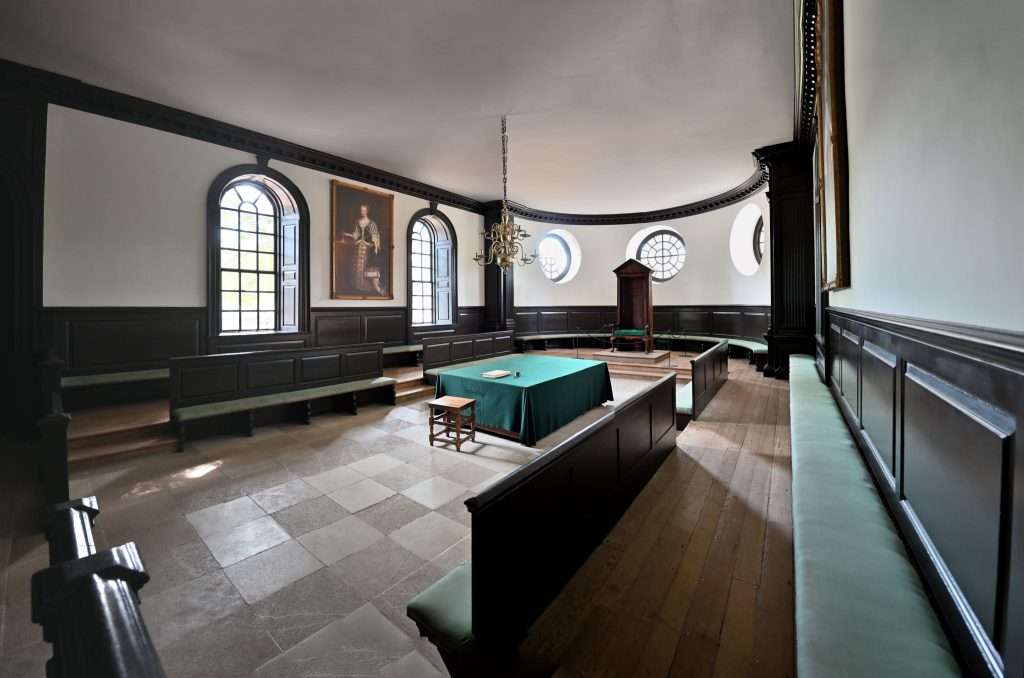
During a session of the Virginia Assembly in May 1770, supporters of the association met to consider a more effective agreement, again suggested by Mason and presented by Richard Henry Lee. Mason proposed a boycott of all merchants who violated the association and recommended the establishment of county committees made up of planters and merchants to enforce the provisions of a new association. On June 22, 1770, an expanded group that included many of the original signers, new burgesses, and many merchants signed a revised association.
To secure the support of merchants and smaller farmers, the new association exempted more goods from the prohibition on imports and raised the price threshold of others. The most important innovation was the establishment of five-person committees, to be chosen by a majority of the signers in each county of Virginia, which were authorized to publish the names of any associators who violated the nonimportation provisions.

The various concessions to merchants gained the support of many traders in places like Alexandria and Norfolk. However, despite success in some counties such as Fairfax County, where more than 330 people signed the association, the majority of counties failed to organize a committee. Enforcement varied widely even in the counties with committees. The greatest threat to the success of the revised association, however, came from the continued increase in British imports, driven by ongoing high prices for tobacco and easy credit from British merchants. Imports into the Chesapeake region reached a colonial-era high in 1771, despite a nearly complete cessation of trade in luxury goods. On July 15, 1771, the associators dissolved the nonimportation association except as it applied to the remaining goods subject to duties “laid for the Purpose of raising a Revenue in America.”
The failure to curtail imports from Great Britain provided striking evidence of the expanded influence of British factors and the shift of the tobacco trade to small producers. The expectation that the large planters might, solely by their example, influence the economic decisions of small farmers had proved illusory. The shortcomings of the association also revealed the extent to which the shortage of domestic manufactures perpetuated a dependence on British trade. Even the most ardent supporters of nonimportation, such as Washington, were unable to replace the imported cloth with which they provisioned the enslaved laborers on their large plantations.
The 1774 Virginia Association

By the time of mounting tensions between the colonies and the Crown in 1774, a collapse in tobacco prices and withdrawal of British credit had created greater common interest among large and small tobacco producers and laid the foundation for a far more successful strategy of commercial resistance to imperial policy. When the assembly met in May 1774, news of the closing of the port of Boston and passage of the other Coercive Acts punishing Massachusetts for the Boston Tea Party prompted Virginia’s political leaders to prepare for a renewal of commercial resistance, this time in close communication with leaders in other colonies. The governor, John Murray, fourth earl of Dunmore, dissolved the assembly on May 26 in response to its approval of a day of fasting in solidarity with Boston. Most of the burgesses reassembled the following day and pledged to renew the boycott of tea and other taxed imports. After learning of associations forming in other colonies, a smaller group of burgesses gathered on May 29 and 30 to discuss a new commercial boycott. On May 31, this group invited all of the burgesses to attend a convention on August 1 and urged them to ascertain public opinion in their respective counties during the intervening weeks.
Throughout the summer, a succession of county meetings gave voice to the widespread popular support for a commercial boycott of Great Britain. A few counties entered into an immediate agreement to halt imports; most instructed their elected representatives to support nonimportation at the August convention. The Fairfax Resolves, likely authored by Mason with assistance from Washington, provided the most detailed outline for the Virginia Convention. In contrast to most other county resolves, they acknowledged the property rights of the East India Company and offered to contribute to a reimbursement for the tea thrown into Boston Harbor once American grievances were redressed. Importantly, the Fairfax Resolves agreed to a strategy that had been viewed as radical but found increasing support: the nonexportation of tobacco to Great Britain, provided planters would have a year to ship tobacco and to reduce their debts to British merchants.
The proposal to halt the export of tobacco, which in Virginia’s tobacco-dominated economy would be tantamount to refusing to pay debts, previously had been a source of division. But by 1773, smaller planters, sometimes in informal associations, were withholding tobacco to pressure merchants following the collapse of prices and an associated credit crisis. The imperial crisis in 1774 gave greater urgency to nonexportation proposals, which were often accompanied by demands to close Virginia courts to suits for the recovery of debts.

When the former burgesses met as delegates to the First Virginia Convention, they agreed to halt all imports of British goods, with the sole exception of medicines, beginning on November 1, 1774. At the same time, all imports of enslaved persons, whether from Africa or the West Indies, would be prohibited. The convention rejected the Fairfax Resolves language regarding reimbursement of the East India Company but agreed to delay nonexportation until August 10, 1775, with the stated intention of allowing Virginia debtors to reduce their debts to British merchants. The agreement urged planters to cease cultivating tobacco and to turn their attention to crops and livestock that would support domestic manufacturers. The association signed on August 6 made no mention of closing the courts to debt actions; but the expiration of an administrative act prescribing court fees provided the justification to close the courts to most civil matters, including suits for debt recovery.
In contrast to the associations of 1769 and 1770, the Virginia Association of 1774 explicitly warned merchants not to take advantage of shortages and to sell goods only at the prices in effect during the previous year. It also recommended that every county select committees to enforce observance of the agreement and to regulate the price of goods. Associators further pledged not to do any business with merchants who refused to sign the nonimportation agreement and county committees were empowered to reship or impound any goods imported in violation of the agreement.
At the Continental Congress in September 1774, the Virginia delegation took the lead in organizing the strategy of inter-colonial resistance to British imperial policy. Richard Henry Lee introduced a motion for a nonimportation agreement and served on the five-person committee that drafted an association closely modeled on the Virginia Association. The Virginia delegation overcame opposition from nearly every colony to its insistence that nonexportation be delayed until the summer of 1775 to allow the shipment of the tobacco produced in 1774. The Continental Association suspended nonexportation until September 1, 1775. Nonimportation of British goods and many commodities from the British West Indies would begin on December 1, 1774. Following the model of the Virginia Association, Congress prohibited the importation of enslaved persons as of the same date. The Virginians were less successful in protecting grain exports to the West Indies, which would end when the other nonexportation provisions went into effect in September 1775. The Continental Association called for a committee in every county and city to enforce the commercial boycott and to exercise even broader authority than that granted by the Virginia Association. By the closing months of 1774, counties throughout Virginia established new committees or reconstituted old ones that became the most powerful governing authority in most parts of the colony.


