


Constitutionalism
A constitution is the highest form of law in any government—establishing its basic structures, procedures, duties, and limits. Most nations have a written constitution, although the extent to which those words are actually binding can vary. In the United States, constitutional law cannot be changed merely by majority rule. Although the people are sovereign, their power to change the Constitution is limited. A super-majority of two-thirds is required to propose amendments and three-fourths to ratify them. Both national and state officials are forbidden to violate the Constitution, even if a majority votes for it. Thus, the U.S. government is considered a constitutional democracy—one in which the people rule, but with limits.
To Begin the World Over Again
The U.S. Constitution arose from the American Revolution (1775–1783), in which thirteen former colonies of Great Britain declared their independence in 1776 and fought to create a new nation. At the time, many Americans envisioned a novel type of government free from kings and nobility. As Thomas Paine famously wrote in Common Sense, “We have it in our power to begin the world over again.”

At first, the newly independent states formed a “league of friendship” through the Articles of Confederation, which were approved by Congress in 1777 and ratified by the states in 1781. This first constitution of the United States proved insufficient to the tasks of nationhood after peace came in 1783. The confederation government had no power to tax or regulate commerce, no national executive or judiciary, and unanimous consent was required for any amendments. As a result, each state retained extensive powers and often acted independently. George Washington expressed his frustration with the lack of power over the union in a letter to John Jay: “If you tell the Legislatures they have violated the treaty of peace [with Great Britain] and invaded the prerogatives of the confederacy they will laugh in your face. … What a triumph for the advocates of despotism to find that we are incapable of governing ourselves.”

Shared commercial interests began to bring some of the states together. In March 1785, the states of Virginia and Maryland negotiated rights over their common waterways at the Mount Vernon Conference. In September 1786, additional states convened at the Annapolis Convention, from which came a recommendation to amend the Articles of Confederation. That winter of 1786–1787 brought an uprising in western Massachusetts known as Shays’ Rebellion, in which unpaid veterans objected to new taxes that caused foreclosures on their farms. As a result, the Confederation Congress passed a resolution in February 1787 calling for a convention in Philadelphia to suggest amendments to the Articles of Confederation.
The Constitutional Convention
On May 25, 1787, delegates from twelve states met in Philadelphia’s State House, now known as Independence Hall. The smallest state, Rhode Island, stayed home. The delegates unanimously elected George Washington, the victorious commanding general of the Continental Army and a Virginia delegate, as president of the convention. Their proceedings were secret, strictly enforced by Washington. Delegates were permitted to change their minds on votes during the course of the convention.
On May 29, Governor Edmund Randolph of Virginia presented the Virginia Plan, principally developed by fellow Virginia delegate James Madison. It set the stage for a new form of government, not just amending the Articles of Confederation. The Virginia Plan created a bicameral legislature, both houses of which would be based either on a state’s free population or the taxes it paid. Smaller states objected because they enjoyed equal representation in the Confederation Congress under the Articles of Confederation. Eventually, a compromise was reached: the legislature would be bicameral, with one house based on population and the other with each state given equal representation.
The second major compromise involved how people were to be counted in the population of each state. These population totals were to include people who could not vote, such as free men without property, women, children, and indentured servants. If enslaved people were counted in a state’s population, that would give more political power to the slaveholding South, especially Virginia, where approximately 40 percent of the population was enslaved at the time. Northern states objected because fewer enslaved people lived there, but they also wanted enslaved people counted for taxation purposes. The convention compromised by counting three-fifths of all “other persons”—avoiding the explicit mention of slavery in the Constitution—for representation in the House of Representatives and for federal taxation in Article I, Section 2, Clause 3.

Other provisions about slavery in the U.S. Constitution included the Slave Trade Clause (Article I, Section 9), which allowed Congress to ban the international slave trade after 1808, and the Fugitive Slave Clause (Article IV, Section 2). This provision required that enslaved people and indentured servants who sought freedom in other states “shall be delivered up” to their enslavers.
The Articles
After almost four months of deliberations, the convention approved a constitution with a preamble and seven articles. Beginning with the words “We the People,” the Preamble declared the principle of popular sovereignty, that all power in the government came from the people. Furthermore, the Preamble stated that the people had placed their power in the Constitution, which gave it the ultimate authority. It also stated that the purposes of the Constitution were “to form a more perfect Union” than what existed under the Articles of Confederation and to “establish Justice, insure domestic Tranquility, provide for the common defence, promote the general Welfare, and secure the Blessings of Liberty to ourselves and our Posterity.”
The main body of the Constitution consisted of seven divisions, or articles. These articles created a system of federalism in which the national government shared power with the existing states. The first three articles divided the national government into branches—legislative, executive, and judicial—that make, enforce, and interpret the laws under a principle known as separation of powers. Article IV dealt with legal relationships between the states, the creation of new states, and protections against domestic violence within states, referring to insurrection, rebellion, or riots. The Supremacy Clause in Article VI made the Constitution, laws, and treaties of the United States the “supreme law of the land.” Furthermore, all federal and state officials in the legislative, executive, and judicial branches were required to take an oath to uphold the U.S. Constitution. However, no religious test was allowed for federal public office. Most importantly, Article V created an amendment process through which the Constitution could be peacefully changed. Article VII set forth the procedures for ratification of the original Constitution.

On September 17, 1787, thirty-eight of the original fifty-five delegates signed their names (one signed both for himself and an absent member) to the document in Independence Hall. Three delegates—Governor Randolph and George Mason of Virginia and Elbridge Gerry of Massachusetts—did not sign the U.S. Constitution because they feared it created a federal government that was too powerful and because it lacked a bill of rights. Since each state voted as a delegation, however, the Constitution was signed unanimously by all states represented.
Ratification
The proposed U.S. Constitution was essentially the report of a blue-ribbon commission called to propose amendments to the Articles of Confederation, so George Washington submitted it to the Confederation Congress for further action. At that point, Congress could have shelved it entirely. But Congress, as the legally constituted government of the United States, instead decided unanimously to submit the document for ratification by the states, under the terms of Article VII. Thus, the new Constitution was created with the cooperation of the existing government and the voters themselves through special ratifying conventions.
Amendments
Since ratification, the Constitution has been amended twenty-seven times, and these amendments tended to come in clusters. The first ten amendments were added in 1791 and are known as the Bill of Rights. They addressed specific concerns raised in state ratifying conventions for the new Constitution, principally that it lacked a bill of rights. North Carolina and Rhode Island refused to ratify the Constitution until those amendments were submitted to the states.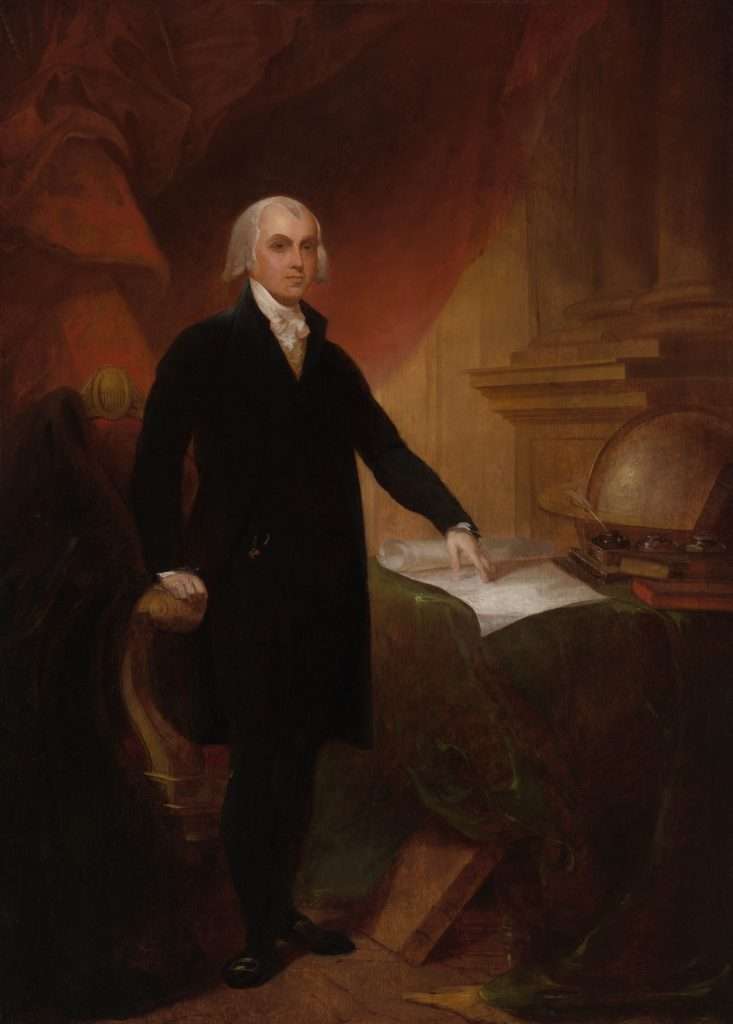
The next two amendments corrected early problems with constitutional interpretation and structure. The Eleventh Amendment affirmed the immunity of state governments against lawsuits in federal courts. The Twelfth Amendment created separate balloting for president and vice president to prevent standoffs between candidates from the same political party, as happened with Thomas Jefferson and Aaron Burr in the election of 1800.

The Constitution was not amended again for sixty years, and then only as a result of the American Civil War (1861–1865). The Thirteenth Amendment ended slavery in 1865, although it allowed “involuntary servitude” for prison terms. The Fourteenth Amendment, added in 1868, was so far-reaching in scope that it fundamentally transformed the U.S. Constitution. It defined as American citizens “All persons born or naturalized in the United States,” including formerly enslaved people. (It did not, however, extend citizenship to most Native Americans, who would not be granted citizenship until Congress passed the Indian Citizenship Act in 1924.) It required uniform legal standards for the states regarding their citizens, including due process and equal protection of the laws. Virginia’s General Assembly refused to ratify the amendment until ratification became a precondition of regaining representation in Congress. Eventually, the Fourteenth Amendment was used to extend the freedoms of the Bill of Rights to state and local governments.
Most of the subsequent constitutional amendments expanded voting rights: the Fifteenth Amendment gave suffrage to Black men in 1870; the Nineteenth Amendment allowed women to vote nationwide in 1920; the Twenty-third Amendment gave residents of Washington, D.C., the right to vote for president in 1961; the Twenty-fourth Amendment abolished the poll tax in 1964; and the Twenty-sixth Amendment lowered the voting age from twenty-one to eighteen in 1971.
Enduring Debates
Certain issues have remained at the forefront of constitutional debate from the founding era to today. The most fundamental is the scope of federal power granted by the Constitution, especially in relation to the states. These tensions are hardwired into the structure of the Constitution. Chief Justice John Marshall wrote in 1819 that such issues “will probably continue to arise, as long as our system shall exist.”

The U.S. Constitution creates a limited national government by dividing power between three branches that each have checks and balances on the other. The framers of the Constitution intended for Congress to be the dominant branch of government; Article I, setting forth the legislative powers, takes up two of the four pages of the original Constitution. Since World War II, however, the president and the executive branch have exercised more power. In the nuclear age, the split-second decisions of the commander in chief have life-or-death consequences for the entire world. Furthermore, Congress has delegated more regulatory power to administrative agencies in the executive branch.
Civil rights and civil liberties protections also expanded after World War II, through legislation, court decisions, and civic action. However, in the twenty-first century, the Supreme Court has curtailed prior rulings on affirmative action, voting rights, and abortion. Such issues raise the question of who decides what the Constitution means and how. When are judges applying constitutional values and when are they substituting their own? Advocates of originalism argue that to be faithful to the Constitution, judges should look to its meaning at the time it was ratified more than 200 years ago. But other Americans believe that exercising judgment is inherent to judging, so that contemporary factors must also be considered.
Ultimately, the people retain the right to shape the Constitution through the amendment process. As Judge Learned Hand stated during World War II, “Liberty lies in the hearts of men and women; when it dies there, no constitution, no law, no court can save it.”


