


Background
Manor Plantation and the people enslaved on it were considered the property of Colonel John Willoughby Sr., a sixth-generation Virginian who represented Norfolk Borough in the House of Burgesses and held various other public offices between 1748 and 1776. Beginning in the summer of 1775, the British fleet stationed around Norfolk under Dunmore’s command raided towns and plantations up and down the coast, carrying off supplies and enslaved people as part of a strategy to undermine Patriots’ morale and sense of security and to destabilize Virginia’s economy. Other enslaved people made their own way to British ships. On November 7, 1775, Dunmore proclaimed martial law and offered freedom to indentured servants and people enslaved by Patriots who joined British forces. In early 1776, based on recommendations from Continental Army officers, the Virginia Committee of Safety mandated the relocation of residents and enslaved individuals from Norfolk and Princess Anne counties to the interior in anticipation of British incursions. Residents protested the order as unjustified, given what they believed to be the faithfulness of the enslaved people in the area.
As Patriots sought to make inroads in the Norfolk area, which was dominated by Loyalists with mercantile connections to the British Empire, Willoughby’s allegiance to the Crown came into question. In November 1775, shortly after issuing the proclamation, Dunmore ordered Willoughby to rally the Princess Anne and Norfolk militias for the king. The order was ignored, and Patriot forces occupied Norfolk in December, arrested Willoughby, and then paroled him. His petition to the Fourth Virginia Convention in Williamsburg sought to “Honourably acquit himself,” contending that his Loyalist oath had been coerced. On January 3, 1776, the convention exonerated him as a “friend to American liberty,” declaring that “whatever he did to the contrary proceeded from compulsion, being himself, and family, in the power of Lord Dunmore.”
The Escape
Under colonial law and custom, enslaved people did not work on Sundays, which meant that they had a window of opportunity before they would be missed. On Sunday, April 14, 1776, under a crescent moon, a flotilla of barges, longboats, and pettiaugers (small, two-masted, flat-bottomed boats) conveyed eighty-seven persons aged between sixteen and sixty—fifty children, twenty-one women, and sixteen men—from the shores of Willoughby Point to the British flotilla anchored in Willoughby Bay. Some evidence suggests that the escape was orchestrated by a covert coalition of British officers, white Virginians with varied motives (including antislavery Loyalists and Patriots, jealous neighbors, and political rivals), and the enslaved people themselves.
The freedom seekers comprised Willoughby’s entire enslaved population, one of the few instances of the large-scale liberation of a plantation’s workforce. Bound by kinship ties and concerned that anyone left behind risked punishment as accomplices, the whole population apparently embraced the principle of “all of us or none of us.” Running away risked retribution. In December 1775, nine men and women were wounded and recaptured near Point Comfort while attempting to reach Dunmore’s Norfolk fleet by boat; the Williamsburg Virginia Gazette ominously predicted they would “soon be made examples of.”
The escape of Willoughby’s entire enslaved force and the fact that he did not advertise in the local Williamsburg newspaper for their return fueled new rumors that he was a Loyalist. A month after the escape, Purdie’s Virginia Gazette alleged that Willoughby was a Loyalist who had accompanied the laborers on their flight and had thus “gone over to our enemies, thereby making himself a vile apostate, and black traitor.” Facing the same accusations, his son, militia captain John Willoughby Jr., indulged “a little in liquor” and threatened to shoot a neighbor. His “distress of mind” and contrition convinced a military court to excuse him.
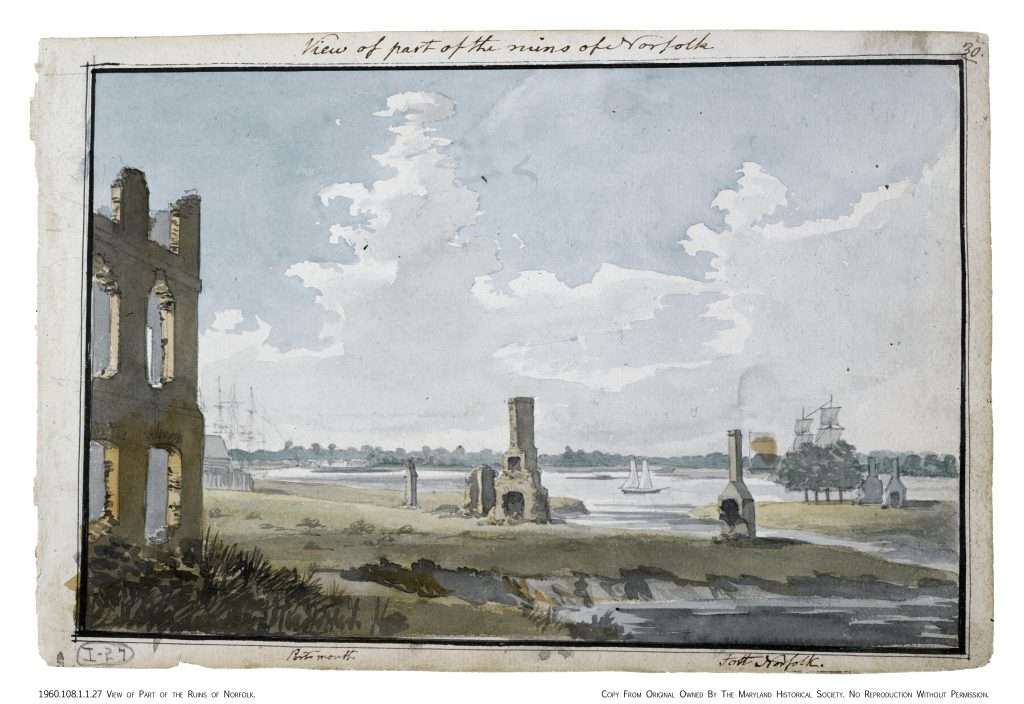
The Willoughbys denied the Virginia Gazette’s allegations and may have threatened a libel lawsuit to restore their reputation. Purdie retracted the charges, praised the Willoughbys’ militia service, and issued a public apology: “It having been incontestibly proved to me, that the report universally believed and circulated last week … is without foundation … [I] am exceedingly sorry for having bestowed unmerited epithets upon gentlemen that do not deserve them.” By August 1776, the Willoughbys had regained the Patriots’ trust, but the colonel lamented the prospect that he would die poor “owing to misfortunes”—the departure of his enslaved workforce and the destruction of twelve houses during the burning of Norfolk.
Captain Willoughby’s unsuccessful June 3, 1777, compensation petition to the Virginia House of Delegates blamed the escape on Patriots rather than the British. He claimed that the family’s enslaved laborers had been subservient until the Virginia Committee of Safety ordered the evacuation of Princess Anne County and Norfolk residents. At that point, the enslaved people fled and “either died, or were carried out of the country, so that none of them were regained.”
Tens of thousands of enslaved Virginians escaped during the war, though exact numbers are unknown. Thomas Jefferson estimated that 30,000 of Virginia’s approximately 271,000 enslaved individuals (11 percent) fled during the British raids of 1781.
After the Escape
The British temporarily relocated the Willoughby escapees to camps at Hampton and Portsmouth. On December 9, 1775, Dunmore’s forces suffered a defeat at the Battle of Great Bridge, and they subsequently abandoned Norfolk and were ravaged by smallpox. In May 1776, Dunmore’s fleet and its Black refugees sailed north to Gwynn’s Island, at the mouth of the Piankatank River on the western shore of the Chesapeake Bay. The liberated Blacks helped to prepare defenses for the island, working as carpenters, cooks, foragers, laundresses, officers’ servants, sawyers, and shoemakers in exchange for food and shelter. Fifteen formerly enslaved men from Willoughby joined Dunmore’s Ethiopian Regiment.

While on Gwynn’s Island, Dunmore’s troops continued to suffer from smallpox and typhus, with mortality rates topping six people per day for a time. An estimated 500 Black Loyalists and 150 white Loyalists perished from disease. After the July 9, 1776, Battle of Gwynn’s Island resulted in another defeat for Dunmore’s forces, the weakened fleet sailed away, with some ships heading to West Florida and the remainder bound for New York bearing what the Virginia Gazette denounced as a “piratical crew” of “black banditti.” Those aboard included 250 people who had formerly been enslaved by ninety Tidewater families, including eleven women and four men of the Ethiopian Regiment who had escaped from Willoughby.
Scattered Lives: New York, Nova Scotia, and Sierra Leone
New York City was a bittersweet sanctuary for British America’s largest community of Black Loyalists. White Loyalists were not universally welcoming, and in February 1779, Mayor David Matthews declared that “Black folk that Came from Virginia” should be “Sent home to [their] Master.” The refugees were defiant, however. Judith Jackson, a laundress who had escaped from Norfolk in 1773, said, “I would not go back to Virginia.” Many of her fellow escapees avoided deportation by voluntarily emigrating to Nova Scotia.
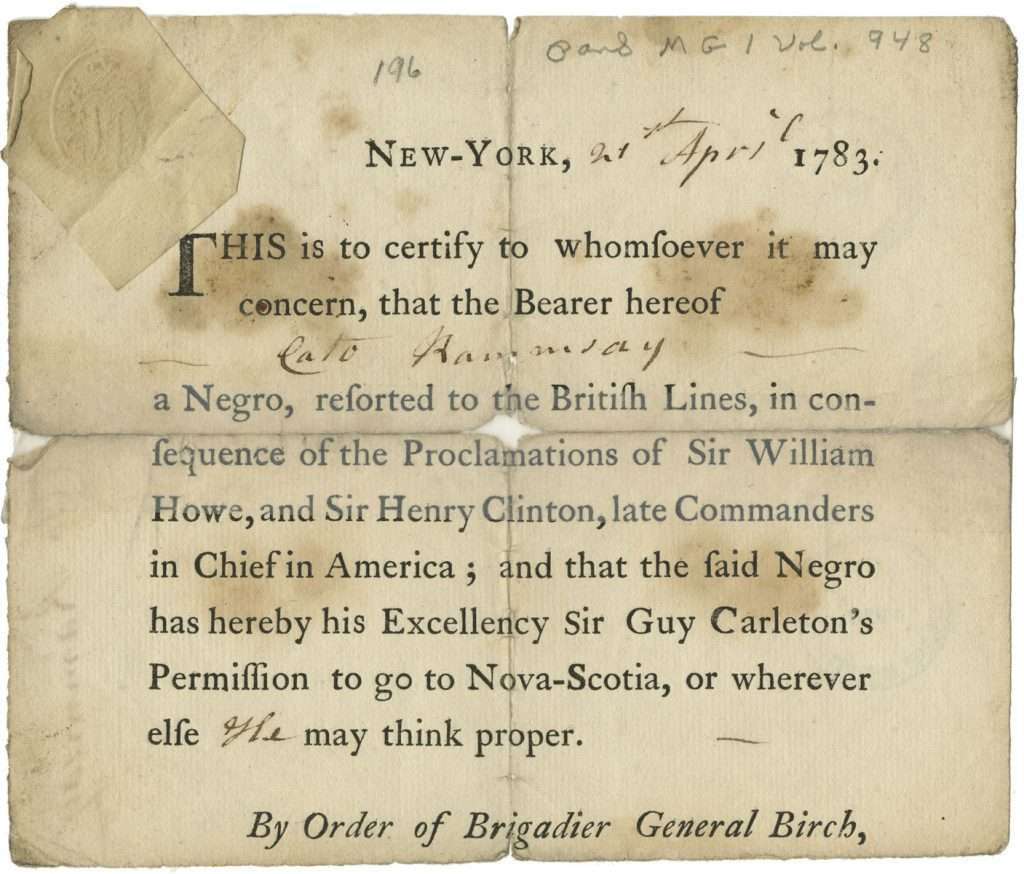
The 1783 Treaty of Paris that ended the Revolutionary War prohibited the departing British from “carrying away any Negroes.” In April of that year, John Willoughby Jr. and other Norfolk County residents traveled to New York City to petition British commander in chief Sir Guy Carleton to return 300 formerly enslaved individuals. Carleton refused that petition, along with all other such requests, on the grounds that upholding Britain’s promise of freedom was a matter of honor. After Carleton oversaw the compilation of a list of all Black individuals eligible for evacuation from New York, Brigadier General Samuel Birch issued freedom certificates that allowed 3,000 Black persons—among them nearly 800 Virginians—to emigrate to Nova Scotia by year’s end. These migrants included seven people from Willoughby who sailed on the HMS L’Abondance on July 31, 1783, after officially attesting that they had absconded from Colonel Willoughby. The fate of the eighty other Willoughby escapees is unknown: they may have succumbed to illness or accidents, been reenslaved, remained in New York, or relocated to the West Indies.
The best documented of the Willoughby freedom seekers is Mary Perth, who was born in New Mill Creek, Norfolk County, around 1740. Willoughby purchased twenty-eight-year-old “Marey” and her three-year-old daughter, Patience, in 1768. Mary subsequently gave birth to two more daughters, Zilpah and Hannah, and adopted two orphan boys, Richard Swan and William Patrick. With the help of antislavery Methodist evangelists, Mary learned to read and write and clandestinely provided spiritual instruction to maroons in the vicinity of the Great Dismal Swamp, walking twenty miles nightly, carrying Zilpah on her back, and returning home before “master and mistress got up.” She married twice, and her second husband likely died while serving in Dunmore’s Ethiopian Regiment.
After her escape, Mary worked as a domestic in Manhattan and married thirty-seven-year-old carpenter Caesar Perth, who had been enslaved near Manor Plantation before fleeing in 1779, and likely knew her in Virginia. Their freeborn daughter, Susan, was born either shortly before the family embarked for Nova Scotia or while en route. The Perths settled in Birchtown, named after the general who had issued their freedom certificates, in Shelburne County, Nova Scotia.

Following a decade of hardships, including discrimination and race riots, the Perths were among 1,200 Black Nova Scotians whom the Sierra Leone Company sponsored as immigrants to West Africa in 1792. Following a harrowing seven-week Atlantic crossing, they set about clearing land for a community they named Freetown. It was a promised land with promises unfulfilled: settlers encountered hostile Indigenous peoples and slave traders and endured a French naval attack, disputes over religious doctrines, and the company’s attempts to achieve what they called an “unreasonable degree” of profit “at their expence.”
Caesar Perth built a house and farmed seven allotted acres prior to his death in 1793. Mary subsequently supported her family as a housekeeper for the colony’s governor and as a Methodist preacher, boardinghouse proprietor, teacher, and storekeeper. She was noted for her piety and her material success. She married her fourth husband in 1806 and died in 1813, a noteworthy story of determined resilience against the dual challenges of slavery and freedom.


