


Debating a Navy
The thirteen British American colonies did not have a navy when fighting broke out at Lexington and Concord, although some colonies did take it upon themselves to defend their coastlines with whaleboats and smaller vessels. The Continental Congress quickly established the Continental Army and chose Virginian George Washington as its commander in chief, but creating a navy was another matter. Whereas the army could be viewed as an extension of the existing militia, creating a navy could be taken as the act of a sovereign nation, and the colonies were nearly a year away from declaring independence.

The question of creating a Continental Navy occupied the Continental Congress in the summer and fall of 1775. Massachusetts delegate John Adams was a vocal advocate for the creation of a navy, arguing that a fleet was essential to protecting colonial ports and harassing the British at sea. Adams wrote that even a small navy “would destroy Single Cutters and Cruizers—it might destroy small Concerts or Fleets of those like Wallaces at R. Island and Lord Dunmores at Virginia.” The debate focused on a nascent navy’s ability to take on the sizable British Royal Navy, which, at upwards of 270 warships, was the world’s greatest sea power, and the costs involved. Adams believed the New England colonies would support a fleet, but thought the southern colonies, including Virginia, would balk because “their whole Trade is carried on in British Bottoms by British, most of it by North British Merchants.”
As the debate in Philadelphia wore on, George Washington found his army in need of supplies, especially powder and weapons. He ordered the outfitting of schooners and manned them with Continental Army soldiers, many of whom were fishermen and other seafarers, to intercept British supply ships. This fleet of some seven repurposed ships became known as Washington’s Cruisers or Washington’s Navy. Historians debate whether this was the beginning of the Continental Navy or simply a force under Washington’s command.

News of two unarmed British brigs sailing for Quebec finally spurred Congress to act, authorizing ships to intercept them on October 13, 1775. This was followed by the British naval attack on Falmouth, Maine, which left the city in ashes. The mood in Congress was shifting. George Wythe argued, “Why should America not have a navy? We have all the materials for construction of a navy.” Many of the other delegates agreed, and on October 30, 1775, the Continental Congress moved forward with plans for a Continental Navy.
Privateers

While Congress debated a navy, Virginia and other North American colonies relied on privateers to protect their ports and attack British vessels. Privateers were privately owned vessels commissioned by Congress to seize enemy ships and cargo in return for prizes—a share of captured ships and goods. Merchants and other entrepreneurs converted their vessels for privateering, adding portholes, adjusting the rigging, and expanding cargo holds. Captains and crews were theoretically bound by instructions from Congress and signed Articles of Agreement that laid out rules and expectations for expeditions, including the share of prizes, but they often acted in their own interests once at sea. Captured prizes were sent to port for adjudication by an Admiralty Court, which determined the legality of a seizure, and privateers could appeal to the Continental Congress if the court ruled against them.
While profit motivated many privateers, patriotism and revenge for British attacks on coastal communities also were factors. At least 2,000 vessels operated as privateers during the war, employing men from all walks of life, including career sailors and novice seamen. Enslaved men were forced to serve as well, with their prize share collected by their enslavers.
Creating the Continental Navy

Esek Hopkins was appointed commander in chief of the Continental Navy on November 5, 1775, at the rank of commodore, not admiral, which meant he was not equal in rank to George Washington. Congress created regulations for the new navy, including payments, punishments, and rations for sailors, and the prizes due the crew from captured ships, which were less lucrative than those for privateers. The first four vessels commissioned were the Alfred, Cabot, Andrew Doria, and Columbus, which were joined by four additional vessels in the Delaware River in early 1776.
Recruiting sailors for the new navy was a challenge, as privateers and state navies drew manpower away from the Continental Navy. Virginia authorized a state navy in December 1775, several months before the first Continental ships were ready to sail. Virginia’s navy celebrated sporadic victories during the war, but the fleet remained small and often was forced to flee larger British and Loyalist vessels. The commonwealth also struggled to recruit sailors, as more lucrative opportunities—particularly privateering—lured sailors away. Continental Navy commanders like John Paul Jones of Virginia and Esek Hopkins of Rhode Island bemoaned the difficulty of recruiting and retaining sailors and blamed privateers and their profit-generating ventures for the lack of support for the navy.
Building a navy from scratch proved difficult, and even when ships were ready to sail, instructions from Congress were not always followed. On January 2, 1776, Hopkins received orders from Congress to sail for the Chesapeake Bay, where Virginia’s royal governor John Murray, fourth earl of Dunmore, had been harassing and plundering the coastal towns, culminating in an attack on Norfolk on New Year’s Day. Hopkins was to gather intelligence and, if the situation proved favorable, “Enter the said bay, search out and attack, take or destroy all the Naval forces of our Enemies that you may find there.” Hopkins was also tasked with attacking British ships along the Carolinas—after presumed success in Virginia—before sailing north.

Hopkins’s small fleet was idled by bad weather until mid-February. When he finally got to sea, he took advantage of a clause in the instructions that allowed him to use his “best Judgment” to
bypass Virginia completely and head for the British port of Nassau in the Bahamas. There he
captured two British vessels and a large quantity of guns and ammunition but failed to capture the damaged HMS Glasgow in what was the first amphibious assault by the U.S. Marines. Hopkins claimed that news of reinforcements to Dunmore’s fleet convinced him his small flotilla was outmatched, but some believed he hesitated to engage Dunmore. The first commander of the U.S. Navy was censured by the Continental Congress for disobeying orders on August 16, 1776, suspended on March 26, 1777, and dismissed from the U.S. Navy on January 2, 1778.
Cruising the Virginia Capes and the Chesapeake

Captain John Barry and the Lexington were more successful. In early April 1776, following orders from Congress, the Lexington was cruising off the Virginia Capes in search of Dunmore’s fleet when the crew spied the British sloop HMS Edward. The ships engaged and exchanged fire. The Edward tried unsuccessfully to lure the Lexington back toward the capes, but was captured. Barry sent Edward to Philadelphia, where it was greeted with cheers from colonists excited to see the first fruits of the Continental Navy’s efforts.
Other Continental commanders, like James Nicholson, were less decisive. After stalling on the pretext of needing more money and men, Nicholson finally sailed the Virginia, along with three other vessels, out of Baltimore in the summer of 1777. The Virginia was soon in the York River, where it encountered the HMS Thames, whose captain, Tyringham Howe, expected a challenge that never came. Nicholson lingered for nearly a week on the Virginia coast before returning to Baltimore without ever engaging the enemy. Pushed by Congress to take action, he did manage to outsail two British frigates, HMS Emerald and HMS Richmond, just beyond Hampton Roads. But his ship ran aground in late March of 1778, and he fled to shore, abandoning his ship and his crew to the British.
Such was the case for the Chesapeake Bay and the waters of Virginia throughout the war. British vessels rarely encountered the Continental Navy, and if they did, the outcome was often in their favor. Henry Laurens of South Carolina lamented that he appealed to Congress to send ships south without much success. He thought New Englanders were far more concerned with their ports and ships than Virginia, North Carolina, and South Carolina, but the underlying issue was that many Continental captains and their crews were motivated more by profit and prizes than the commands of the Continental Congress, and the waters off New England and the Caribbean offered far richer prizes than the coastal South.
Congress’s Marine Committee could not entirely ignore the southern states. On March 13, 1779, the Warren, Ranger, and Queen of France set forth on a cruise of the southern coastline to protect trade, and, if possible, enter “the mouths of Delaware and Chesapeake for the purpose of destroying the small armed Vessels from New York that lurk about the Capes to the certain destruction of almost every Merchantman that sails.” The ships captured eight British ships loaded with provisions and equipment, but instead of following the orders of Congress and continuing the expedition, the commanders accompanied their prizes back to Boston, infuriating the Navy Board.


The most significant naval action in the waters of Virginia was the Battle of the Capes on September 5, 1781, but neither the Continental Navy nor Virginia’s navy was involved. The French fleet under Admiral François Joseph Paul de Grasse defeated the British Royal Navy under Admiral Sir Thomas Graves. A commander had finally seen the significance of the waters of the Chesapeake, but he was not from the Continental Navy.
The Decline and Demise of the Continental Navy
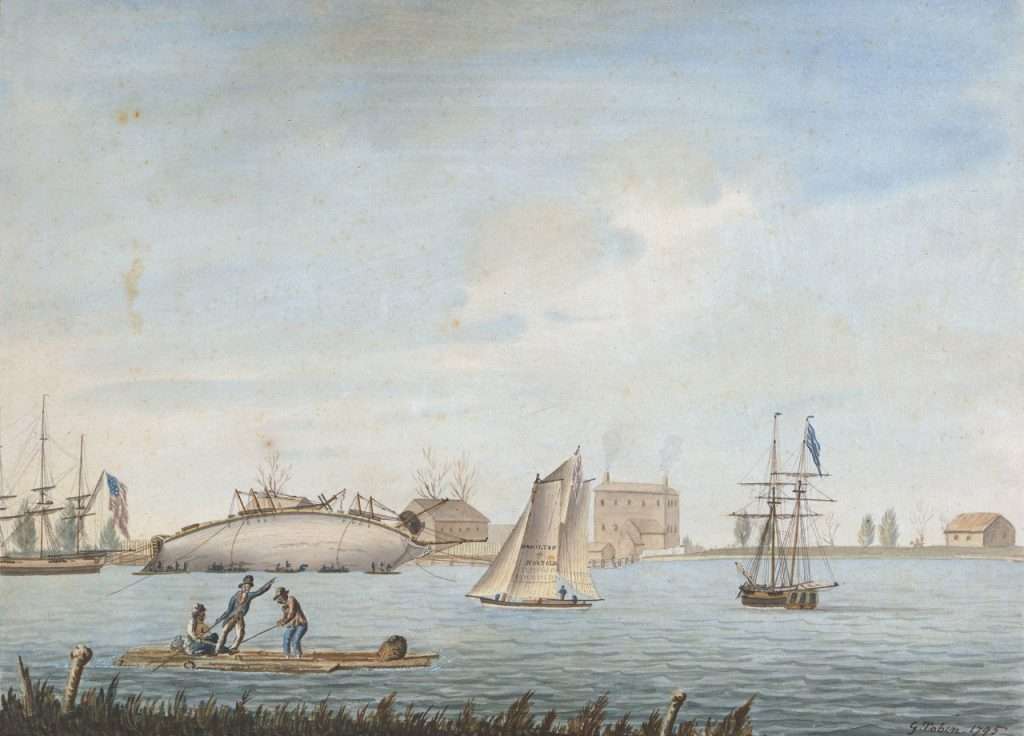
The Continental Navy outfitted about sixty-five ships during the course of the war, but only five survived by the end of the conflict. Most were taken by the British or destroyed. Two frigates that were supposed to be built in Virginia were never completed; work on them seemed barely begun. With no need for a navy, the few remaining ships were sold. The last vessel of the Continental Navy, the Alliance, was auctioned for $26,000 on August 1, 1785, ending the Continental Navy.


