


What are Rights?
A right is a social norm supported by morality, tradition, or law. There are different categories and sources of rights. The most fundamental rights are natural rights, also known as human rights. They are inherent to a person by birth, whether divinely inspired or based in human nature. Legal rights are those rights protected by law, but the law can also take these rights away.

According to the most famous sentence in the Declaration of Independence, “all men are created equal” and their Creator gives them “certain unalienable rights,” meaning natural rights, which cannot be bartered or given away. These rights include “life, liberty, and the pursuit of happiness.” The very purpose of government, according to the declaration, is “to secure these rights.”
Although rights are declared in the Declaration of Independence, it does not establish a legal system through which those rights can be protected. An important legal maxim states that there is no right without a remedy. Unless a right can be enforced by law, it does not exist as a practical matter.
English Origins
When English colonists arrived in North America, they brought with them a long history of disputes about rights. Over many centuries, the “rights of Englishmen” evolved into a birthright that American colonists believed they inherited from the mother country. Although England did not have a written constitution, it did have significant documents that affirmed certain rights.
One of the earliest of these was Magna Carta (Great Charter), sealed by King John in 1215. Until that time, the divine right of kings meant that the monarch ruled by God’s authority and was subject only to God. But the Magna Carta asserted that there were limits to the king’s power, at least where his noble barons who drafted it were concerned. Among these rights were due process of law and trial by a jury of their peers, or fellow nobles. What the king giveth, however, the king can taketh away. John and subsequent kings did not always follow the Magna Carta.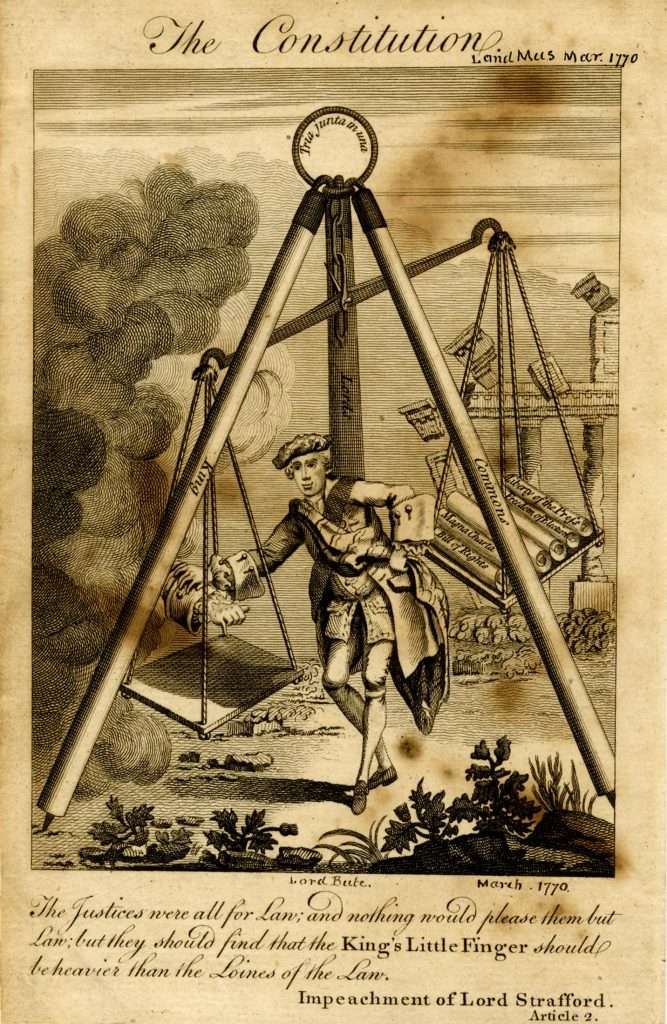
Another major document was the English Bill of Rights 1689, adopted by Parliament during the Glorious Revolution that deposed James II as king. The term “bill” of rights refers to the document’s origins as a piece of legislation in Parliament. William and Mary of Orange (a region in the Netherlands) were invited by Parliament to assume the monarchy if they ascribed to the bill of rights. Included in the English Bill of Rights were the right to petition the king and to bear arms, as well as a prohibition on excessive bail and fines and a ban on cruel and unusual punishment. But what Parliament giveth, Parliament can also taketh away. The U.S. Bill of Rights differs because it cannot be changed merely by majority vote in Congress.
Rights and Revolution
Unlike their English cousins, whose constitution was largely unwritten, North American colonists had a strong preference for putting rights on paper. This practice was rooted in the Protestant Reformation, which emphasized documents written in the common vernacular that were accessible to all. The Massachusetts Body of Liberties, enacted in 1641, was the first detailed protection of individual rights among the colonies. Colonial charters and laws also protected rights, with many promising new settlers that the “rights of Englishmen” would be protected.
Given the vast distance from England, American colonists experimented with various forms of self-government for 150 years before the American Revolution. As tensions grew between Parliament and the colonies over taxation without representation, the colonial legislatures asserted their rights. In 1765, the Stamp Act Congress, representing nine colonies, protested the first direct tax on the colonies by issuing a “Declaration of Rights and Grievances,” which demanded the rights of Englishmen for the colonists and included the right to petition and to a jury trial. In 1774, the First Continental Congress issued a similar “Declaration and Resolves.”
Two years later, the die for revolution had been cast. In June 1776, Virginia declared itself independent from Great Britain and created its own constitution prefaced by a declaration of rights. The Virginia Declaration of Rights, written by George Mason, contained some of the same language about government and rights later repeated in the Declaration of Independence. Moreover, Virginia’s bill of rights was part of the state’s constitution, its highest form of law, and could not be easily changed by statute. In both legal status and content, the Virginia Declaration of Rights was a direct predecessor to the U.S. Bill of Rights.
Thomas Jefferson argued the case for revolution in the Declaration of Independence, asserting Americans’ most fundamental rights as “self-evident,” like a mathematical proof. They were also God-given, for double protection. Among his list of complaints against King George III were claims that the king incited “domestic insurrections” among enslaved people and attacks by “merciless Indian Savages” on the frontier. But enslaved and Native people also sought to assert their rights. Native nations allied with different warring parties in the American Revolution to protect their sovereign rights. African Americans, too, had varied interests—in Massachusetts quoting the Declaration of Independence to argue for their freedom from slavery, in Virginia joining forces with the British under promises of freedom, and in North Carolina fighting as free Patriots to defend their land.
Some women also sought to claim rights. During the debates over independence in Congress, Abigail Adams famously warned her husband, John Adams, to “remember the ladies” in the new government, because if not, she warned, “we are determined to foment a rebellion, and will not hold ourselves bound by any laws in which we have no voice or representation.” He laughingly dismissed her concerns.
Constitutional Rights
The nation’s first constitution, the Articles of Confederation, was adopted in 1781. It contained no bill of rights, but the government it created was very limited. Without an external enemy to unite them, the United States of America began quarreling like jealous siblings, with each state trying to be a sovereign nation. Yet a strong central government seemed too much like the king the country had just overthrown. A revolt by tax-burdened and unpaid veterans in western Massachusetts, known as Shays’ Rebellion, fueled the drive for changes to the Articles of Confederation.
As a result, the Confederation Congress called a federal convention to amend the Articles of Confederation. On May 25, 1787, delegates from every state except Rhode Island began deliberating in Philadelphia. They quickly abandoned the Articles of Confederation and created a new frame of government composed of three branches: legislative, executive, and judicial. This separation of powers, along with checks and balances between the branches, served to limit the new national government, which continued to share powers with the states.
Only days before the convention ended, George Mason noted the absence of a bill of rights in the new constitution and said he would “sooner chop off his right hand” than sign the document without one. Mason argued that such an addition would only take a short time. But the joint motion by Mason and Elbridge Gerry of Massachusetts was defeated unanimously.
On September 17, 1787, after almost four months of deliberation, thirty-nine of the fifty-five delegates still present signed the final draft of the proposed U.S. Constitution (one delegate signed in absentia). Three delegates refused to sign: Mason, Gerry, and Edmund Randolph of Virginia. George Washington, president of the convention, transmitted the signed copy to the Confederation Congress, which agreed to send the document to the states for ratification, without official approval.
Then the real battle began: would the state ratifying conventions approve the document as is, insist that amendments be added before or after they ratified it, or perhaps most radically call for a second constitutional convention to redo it entirely? A consistent theme among the state ratifications was the U.S. Constitution’s lack of a bill of rights, which became its chief stumbling block.
Supporters of the new constitution, known as Federalists, urged its ratification even without a bill of rights. Their most powerful arguments, published in a series of newspaper articles in New York from October 1787 until May 1788, were compiled as The Federalist. Alexander Hamilton, writing in Federalist 84, argued that “the constitution is itself in every rational sense, and to every useful purpose, a Bill of Rights.” In his view, the very structure of a limited government established by the Constitution protected the rights of its citizens, and listing rights specifically could imply powers not granted.
Thomas Jefferson took the opposite view. In a letter to James Madison, one of the chief architects of the new constitution, he wrote that “a bill of rights is what the people are entitled to against every government on earth, … and what no just government should refuse, or rest on inference.” Mercy Otis Warren, an ardent Anti-Federalist writing as “A Columbian Patriot,” opposed the ratification of the Constitution by her state of Massachusetts for similar reasons: “The very suggestion, that we ought to trust to the precarious hope of amendments and redress, after we have voluntarily fixed the shackles upon our own necks should have awakened to a double degree of caution.”
The new constitution was ratified by the necessary nine states on June 21, 1788. More importantly, the large states of Virginia and New York quickly followed suit. But no sooner had they ratified than motions began for a second constitutional convention.
Madison’s “Nauseous Project”
When the First Congress under the U.S. Constitution convened in early 1789, Madison represented Virginia in the House of Representatives. True to his campaign promise to the voters of Virginia, he set out to secure passage of proposed constitutional amendments. Though Madison had voted against a bill of rights at the Constitutional Convention, he saw at the Virginia ratifying convention that one would be necessary to stabilize the new government.
Madison first raised the idea of amendments on May 4, 1789, but Congress was more focused on raising revenue. Madison persisted and introduced his proposed amendments on June 8, citing movements for a second constitutional convention in New York and Virginia. Madison sprinkled his amendments throughout the Constitution, with most appearing in Article I, Section 9, which set forth limits on the powers of Congress. He also included a provision that would have forbidden states from violating “the equal rights of conscience, or the freedom of the press, or the trial by jury in criminal cases.”
Madison’s proposed amendments were criticized by both his Federalist colleagues in the House of Representatives and the Anti-Federalists he was seeking to placate. Mason criticized Madison’s amendments as “th[r]owing out a Tub to the Whale”—a reference to the maritime practice of diverting a whale from attacking a ship by throwing it a tub—meant to distract citizens from the larger threat posed by the new federal government. By the end of the summer, Madison himself referred to the “nauseous project of amendments” that required all his political skill.
But Madison’s hard work and persuasive skills paid off, and on August 24, 1789, the House voted to condense Madison’s list into seventeen amendments to be added to the end of the U.S. Constitution. It deleted the restriction on state infringements of civil liberties, although Madison thought it to be “the most valuable amendment on the whole list.” This action would prove crucial to later judicial interpretations of the scope of the Bill of Rights. The Senate further reduced the proposed amendments to twelve, and they were submitted to the states on September 25, 1789.
As expected, the proposed bill of rights brought North Carolina and Rhode Island into the union. The Bill of Rights became final with Virginia’s ratification on December 15, 1791. However, the states only approved ten of the proposed twelve amendments. The failed amendments concerned apportionment of congressional districts (the proposed formula would result in more than 7,000 members of the House of Representatives today) and delaying any congressional pay raises until after an intervening election. (This amendment finally was ratified as the 27th Amendment in 1992.)
Under the new configuration, the proposed third amendment became the First Amendment, protecting the landmark freedoms of religion, speech, press, assembly, and petition. The Second and Third Amendments guarded against the Constitution’s new standing army by including the right to bear arms and preventing troops from being quartered in private homes.
Of the remaining amendments, most secured the rights of those accused and convicted of crimes, a process very familiar to the founding generation. These rights include a ban on “unreasonable searches and seizures” and a process for issuing warrants in the Fourth Amendment; protections against double jeopardy—being tried twice for the same crime—and self-incrimination in the Fifth Amendment; the right to a speedy and impartial trial by a jury in the Sixth Amendment; and a ban on excessive bail and “cruel and unusual punishments” in the Eighth Amendment.
Other rights regarding the civil, or noncriminal law, also are protected. The Fifth Amendment secures due process of law, or fair procedures, in both criminal and civil law, as well as “just compensation” when private property is taken for public use. The Seventh Amendment ensures the right to trial by jury in civil cases, such as those concerning contracts and personal injury. The Ninth Amendment protects rights not specifically listed in the Bill of Rights, and the Tenth Amendment retains any powers to the states not delegated to the federal government in the U.S. Constitution. This was the most popular amendment suggested by the state ratifying conventions, likely to protect their status in the new federal government.
Legacy
The U.S. Constitution and Bill of Rights were designed to create a government that protects rights, although in the beginning those rights were extended to a limited few. In 1787, the only people who could vote were white men with property, human slavery was legal, married women had no legal personhood or rights independent from their husbands, and Native Americans had little legal protection. Over time, these rights have expanded to embrace more and more people.
After the Civil War, the Thirteenth Amendment abolished slavery and the Fourteenth Amendment transformed the U.S. Constitution by granting “equal protection of the laws,” which began the long legal process of treating all Americans more fairly. The Supreme Court also eventually used the Fourteenth Amendment to apply the Bill of Rights to the states, whereas before it had only applied to the national government. Other amendments extended the right of suffrage to men of all races, women, and young people age eighteen and above. Native Americans were not granted the right to vote as U.S. citizens until 1924.
The Bill of Rights is part of the U.S. Constitution, so it cannot be changed by a simple majority of voters. Rather, amendments must be proposed by a super-majority of two-thirds in Congress or state conventions and ratified by three-fourths of the states. Thus, the Bill of Rights is not subject to every change in popular opinion. But ultimately, it depends on the support of every American to endure. As Judge Learned Hand said during World War II: “Liberty lies in the hearts of men and women; when it dies there, no constitution, no law, no court can save it.”


