


Early Life and the Brafferton Indian School

Mush was born around 1758 on the Pamunkey Indian Reservation in King William County. At the time of his birth, the Pamunkey Tribe was fulfilling a condition of the 1677 Articles of Peace that had been negotiated with Governor Alexander Spotswood in 1711. Instead of sending an annual tribute, the tribes sent boys to be educated in English customs and language at the Brafferton Indian School at the College of William and Mary in Williamsburg. Mush was one of the boys sent in 1769, when he would have been about eleven years old, and he attended until about 1774. He and other members of his tribe, along with boys from other tribal nations from across the English colonies, learned to read, write, and speak the English language and received instruction in the Anglican religion. Mush’s education had a significant impact on the rest of his life and influenced the choices he made as an Indigenous person.
Revolutionary War

While Mush was a student, Williamsburg was a bustling political center serving as Virginia’s colonial capital. As Patriot sentiments rose in the years leading up to the Revolutionary War, Mush likely would have been exposed to protests against the Stamp Act and imported British goods. Although Mush was a part of the Pamunkey Tribe, whose government had treaties with the Crown, and was attending a British-chartered educational institution, he was also surrounded by ideas of revolution and independence. In the autumn of 1776, at the age of eighteen, Mush and other Pamunkey Brafferton students enlisted for three years in the 15th Regiment of the Virginia Continental Line under Colonel David Mason. His regiment was soon attached to a company under the command of Captain James Gray that fought in the Battle of Middlebrook in New Jersey. Mush also saw action at the Battle of Brandywine Creek and the Battle of Germantown in Pennsylvania before wintering at Valley Forge with General George Washington. Like many soldiers at Valley Forge, Mush became ill, and by January 1778, he was home on furlough to recover. Mush subsequently reenlisted for the duration of the war under Colonel William Russell, who led the newly recombined 7th and 15th Virginia regiments. Mush was sent to Charleston, South Carolina, under Captain William Mosby for the siege of that city, during which Mush was taken captive. In July 1781, after fourteen months as a prisoner of war, Mush was released as part of a prisoner exchange at Jamestown. He reenlisted for another eighteen months and may have been present at the Battle of Yorktown.

After the British surrender at Yorktown, Mush’s unit marched south under Colonel Thomas Posey to Georgia, where skirmishes were still taking place. Mush’s unit joined the forces of General Anthony Wayne in Georgia, where they successfully repelled an attack by the British and their Creek and Cherokee allies. Wayne eventually concluded peace treaties with the tribes. Mush was discharged in July 1782, shortly after the British evacuated Savannah, and returned to the Pamunkey Indian Reservation.
Following the War
Mush would have had to walk or procure transportation to travel the approximately 500 miles back to the Pamunkey Reservation. The journey could have been dangerous for Mush, given the different legal classifications of Indigenous peoples and other free peoples of color. While King William County recognized the legal status of Virginia Indians residing on reservations, those rights were not guaranteed outside of that jurisdiction.
By the time he returned home, Mush would have been about twenty-four years old and a voting citizen of the Pamunkey Tribe, eligible to participate in the tribal government and request an allotment on the reservation to build a home. Sometime between October 1782 and August 1783, Mush married a Pamunkey woman named Elizabeth in a traditional Pamunkey ceremony. They went on to have nine children.
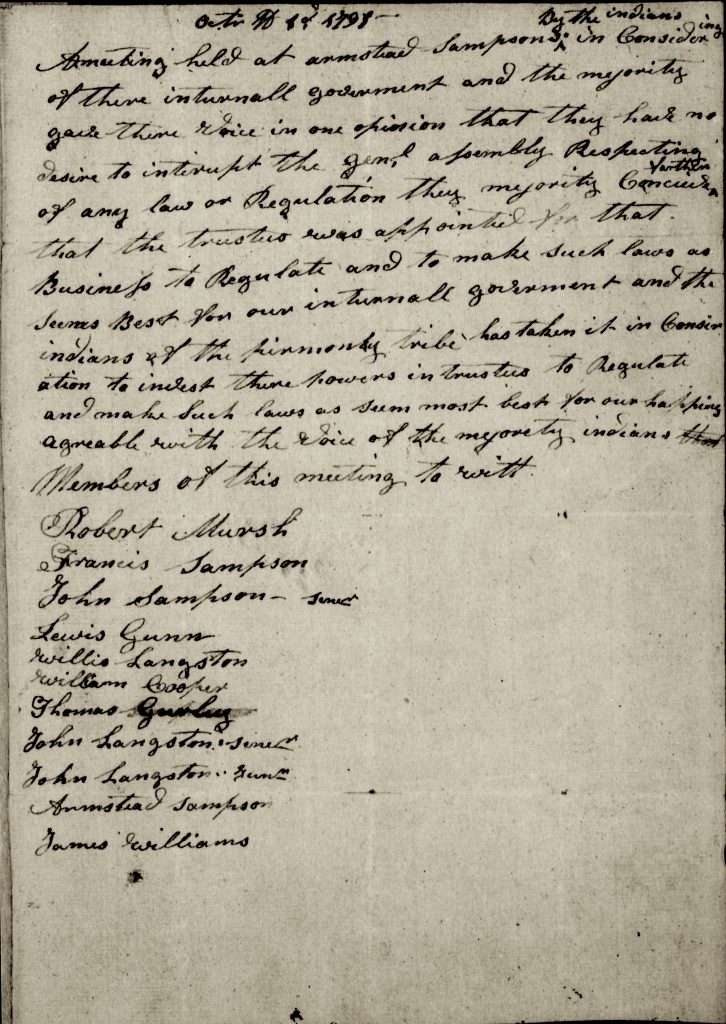
By 1798, Mush had become a leader of the Pamunkey Indian Tribe, likely as a result of his education and ability to read and write. He was the first signatory of an October 4, 1798, petition in which male Pamunkey citizens voted to enable the tribe’s trustees to represent their interests in the General Assembly. This indicates that he likely was serving as chief at the time.
The Baptist Church
The Baptist faith continued its growth in Virginia following the disestablishment of the Anglican Church in 1786 and a series of revivals that had spread through the Williamsburg region in the mid- and late 1780s. The Baptist Church became particularly popular among the region’s Indigenous people. When the Lower College Baptist Church (now Colosse Baptist Church) was organized in King William County in 1791, a number of Pamunkey families were among the charter members, though this group did not include Mush and several other former Brafferton students. In 1797, Robert Mush and Elizabeth Mush converted to the Baptist faith and were remarried in the church, publishing their “marriage bonds” three times. By 1798, Mush was a Baptist minister preaching at the Pamunkey Reservation, where outdoor services were commonly held when members could not travel to Lower College.

In 1800, Mush moved his family to Lancaster County, South Carolina, to continue his ministry, joining his former Brafferton classmate and fellow Revolutionary War veteran John Nettles, a Catawba tribal citizen. Preaching alongside Baptist missionary John Rooker, the two Indigenous men built a church and mission school on the Catawba Reservation, where they taught Catawba children not only the Baptist faith but also some of the English customs they had learned at Brafferton. In about 1806, Mush moved his family to nearby York County, where he served under Rooker as assistant pastor of the thriving Flint Hill Baptist Church, with Nettles serving as a deacon.
Pension Application and Death
On October 25, 1820, Mush appeared before the York County Court to testify to his service in the Revolutionary War as part of his application for a pension under a program created by the U.S. Congress in 1818 for financially needy veterans. Mush provided a copy of the family Bible listing the birthdates of each of his children and some of his grandchildren. He also inventoried his possessions: “50 acres of poor land,” two cows, two horses, hogs, and books, among other household furnishings. Although his pension was approved, Mush did not receive any money before his death on December 7, 1837.

In 1848, Elizabeth Mush filed a request to receive funds owed to her as Mush’s widow. Their children were questioned about their knowledge of Mush’s military service and the legitimacy of the marriage. In March 1848, Elizabeth Mush was awarded a pension of $80 annually.
Some of Mush’s children and grandchildren married citizens of the Catawba Tribe. When ethnologist Albert Gatschet visited the tribe in 1881, he noted several descendants of a John Mush who had died in 1860.
Robert Mush leveraged his education at Brafferton to navigate the complicated political, economic, and social spaces in which he and his family lived as Indigenous people in the revolutionary era.


