

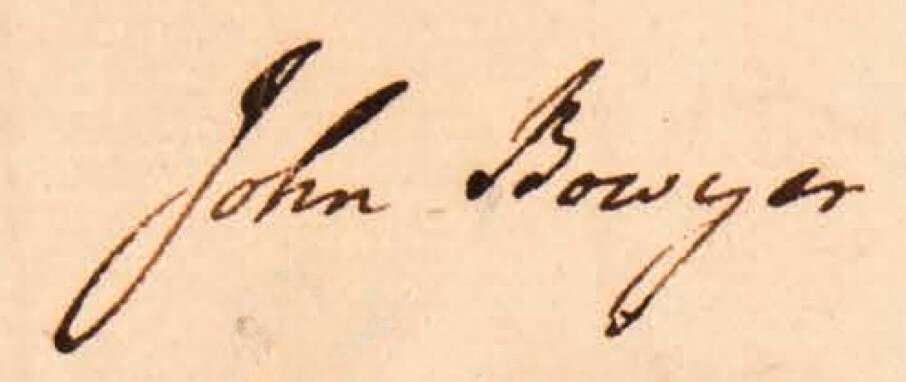
John Bowyer was the son of Michael Bowyer, a Shenandoah Valley pioneer. The date and place of his birth and the identity of his mother are not known. Bowyer was a young man with little property in the autumn of 1753 when he started teaching school in Augusta County. On February 4, 1754, he married very well to a twice-widowed older woman, Magdalene Woods McDowell Borden, and he became the guardian of her underage children. Financially independent after his marriage, Bowyer became a captain in the militia and by 1757 was a justice of the peace, although his gambling (sometimes on the bench even while court was in session) and his violent temper brought him into occasional conflict with his fellow justices.
Bowyer eventually acquired a substantial amount of land near the James River in the southern part of Augusta County. He was sheriff of the county when the area in which he lived was carved off to form the new county of Botetourt at the end of 1769, and he was immediately appointed a justice of the peace for the new county. Bowyer represented Botetourt in the House of Burgesses from 1770 until 1776 and sat in all five of the Revolutionary Conventions. As a member of the Convention of 1776, which unanimously voted for independence and adopted the Virginia Declaration of Rights, he served on the large and distinguished committee that reported the draft declaration and the first constitution of the commonwealth. Bowyer also served in the House of Delegates in 1776 and 1777, and, following the formation of the new county of Rockbridge in 1778, he represented it that year and again in 1782, 1784–1786, 1789–1796, and 1799–1802. He served at different times on the Committees of Courts of Justice, Privileges and Elections, Propositions and Grievances, and Public Claims. Because of alterations in county lines, Bowyer held important positions in three counties without moving.

Bowyer was the first presiding justice of the Rockbridge County Court, served as county lieutenant throughout the 1780s, and in 1780 became Rockbridge’s second sheriff. In January 1781, when the British invaded Virginia, he marched more than 200 men down to the Tidewater, but he returned home in April and was not, as has been asserted, the Colonel Bowyer reportedly wounded and captured at Jamestown early in July 1781. Bowyer was a member of the board of trustees of Liberty Hall Academy, which later became Washington and Lee University, when it received its first charter in 1782. On August 12, 1784, after the death on an unknown date of his first wife, he married Mary Baker in a Presbyterian ceremony in Botetourt County. Bowyer is not known to have had any children with either wife.
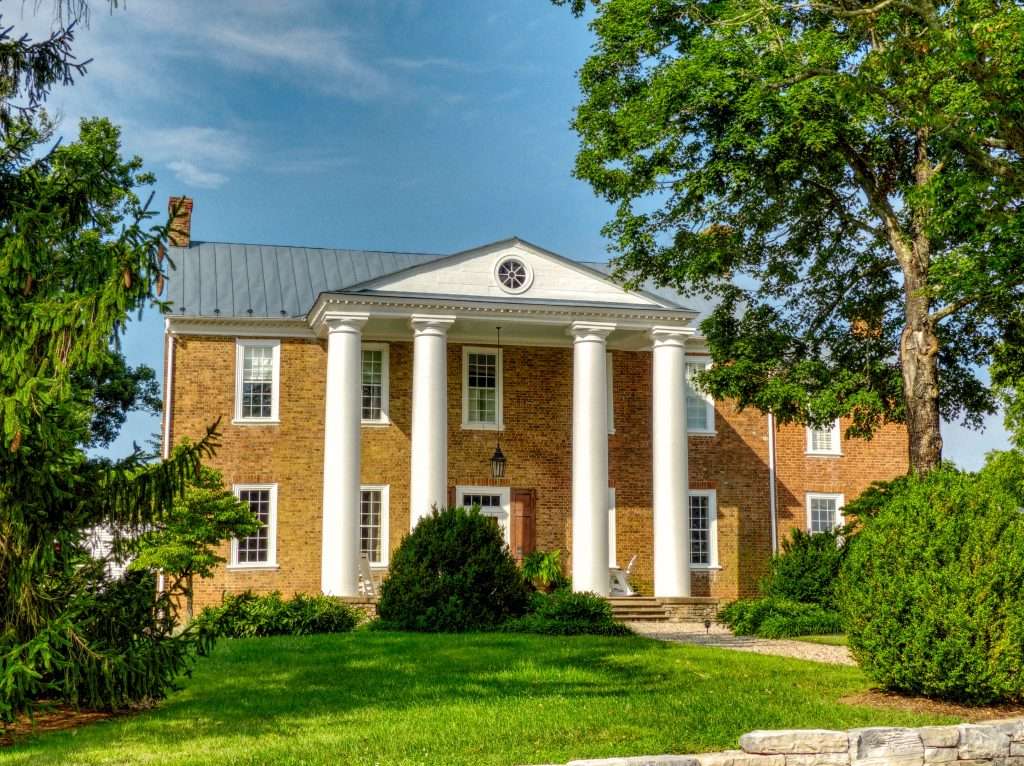
When the state militia was reorganized in 1792, Bowyer was appointed brigadier general of the 13th Brigade. References to him thereafter as General Bowyer usually distinguish him from his namesake nephew and principal heir, who was a well-known attorney in Augusta and Rockbridge counties. The following year, Bowyer began construction of Thorn Hill, a large brick residence of Georgian design with fine interior detailing, on his property near Lexington. He served as a presidential elector in 1792, sat on the Republican committee in Rockbridge County early in 1800, and was chosen in December of that year as a presidential elector for Thomas Jefferson. Bowyer was too feeble to attend court by 1804. When he wrote his will on May 7, 1804, he owned three tracts of land totaling about 1,325 acres in Rockbridge County. After his second wife died, he added a codicil to his will on November 9, 1805. Bowyer died at his home on April 24, 1806, and was buried in Lexington.


