


Early Life
Walker was the son of Matilda Galloway Walker Grant and her first husband, who was most likely Sabinas Walker, and was born probably in Binghamton, New York, on August 1, 1832. He grew up in the household of his mother and stepfather, Donald Grant, in Broome County. Walker attended Williams College, in Williamstown, Massachusetts, and Hamilton College, in Clinton, New York, from which he graduated in 1854 and received a master’s degree three years later. He settled near Binghamton, studied law, began his practice, and married Olive Evans on April 15, 1857. They had one child who died very young. A Democrat, Walker ran unsuccessfully for prosecuting attorney of Tioga County before moving to Chicago in 1859. He had weak lungs, probably incipient tuberculosis, and continued to practice law rather than serve in the army during the Civil War.
Political Career
Despite his health issues Walker was a young man of striking appearance, six feet two and a half inches tall, lean, and with a luxurious mustache readily recognizable from a considerable distance. About 1864 he visited eastern Virginia, either on a business venture or in search of relief from the Chicago weather, and in the autumn of that year moved to Norfolk. There Walker practiced law, prospered, and quickly rose to prominence. He and other Norfolk business leaders and attorneys sought and received charters from the General Assembly of the Restored Government early in 1865 to form three corporations, the Norfolk Steam Navigation Company, the Norfolk and New York City Railroad Company, and the Norfolk Insurance and Trust Company. By the summer of 1865 Walker had become president of the Exchange National Bank, a member of the board of the Fire, Life, and Marine Insurance Company of Norfolk, and not long thereafter a member of the board of the Norfolk and Petersburg Railroad Company, for which he helped to borrow money from New York bankers in 1867. In 1866 Walker had become a member of two other boards of directors when the General Assembly granted charters to the Atlantic Dock and Iron Company and to the Virginia and North Carolina Land, Emigration and Colonization Society, of which William Mahone was also a board member.

A few days before the October 22, 1867, election of delegates to the constitutional convention that Congress required Virginia to hold, opponents of radical Reconstruction in Norfolk, styling themselves Conservatives, nominated two men for the two seats allotted to the city in the convention, one of whom was Walker. He finished a close third in a five-member field of candidates behind Thomas Bayne, a dentist and formerly enslaved person, and white Virginia unionist Republican Henry Moseley Bowden. Walker refused to attend the convention in December 1867 at which opponents of Congressional Reconstruction organized the new Conservative Party and aligned himself with moderate Republicans in Virginia. Republicans controlled Congress and would set the terms by which Virginia’s senators and representatives could take their seats and thereby end Congressional Reconstruction. Early in 1869 Walker endorsed the efforts of what was called the Committee of Nine to arrange with Congress and the president to hold a ratification referendum for the radical new state constitution, which permitted African American suffrage, and to allow Virginia’s voters an opportunity to defeat clauses that disfranchised many former Confederates.
In March 1869 the Republican State Convention nominated Henry Horatio Wells, the radical incumbent governor and military appointee, for governor and an African American physician, Joseph Dennis Harris, for lieutenant governor. William Mahone, a former Confederate officer and railroad company president, and others arranged for Walker to run for governor as a moderate Republican with native Virginia unionist Republican candidates for lieutenant governor and attorney general. The Conservative Party’s candidates and leaders endorsed Walker’s ticket to create a united opposition to the radicals. On July 6, 1869, the state’s voters ratified the new constitution, removed from it the clauses to disfranchise former Confederates, and elected Conservative majorities to both houses of the General Assembly. On that day Walker defeated Wells 119,535 to 101,204.
The commanding general of the First Military District appointed Walker to replace Wells as provisional governor, and Walker took the oaths of office in the governor’s mansion on September 21, 1869. The newly elected General Assembly met in special session on October 5 to ratify the Fourteenth and Fifteenth Amendments to the Constitution as Congress required, and on January 26, 1870, the president signed an enabling act Congress had passed, officially the end of military oversight of the state government in Virginia. The thirty-seven-year-old governor then published a formal inaugural address on February 8.
Under the Constitution of 1869, Walker was the first governor since independence with the constitutional authority to veto bills the assembly passed, subject to a two-thirds vote of both houses to override a veto. On May 23, 1870, he issued his first veto, and after the session concluded he vetoed four other bills, all of which he believed included provisions inconsistent with the new state constitution. Later in the autumn of 1870 Walker vetoed a sixth bill for the same reason.

In his inaugural address and his annual messages to the General Assembly Walker urged Virginians to accept and adapt to the abolition of slavery and all the changes Congress had imposed on the state, including African American suffrage and protecting the citizenship rights of formerly enslaved people. He endorsed and signed the bill in 1870 to create a racially segregated new statewide system of free public schools, and he recommended applying federal land grant revenue to finance schools for freedpeople. In 1872 the assembly passed legislation directing one-third of the funds to Hampton Normal and Agricultural Institute (later Hampton University) and directing the remaining two-thirds to the newly created all-white Virginia Agricultural and Mechanical College (later Virginia Polytechnic Institute and State University). Walker proposed to revive the state’s economy by encouraging railroad and canal construction and advocated attracting European immigrants to Virginia, presumably to take the places of enslaved laborers. The governor criticized the practice of leasing convicted felons to private businesses and recommended establishing a separate prison system for men under age eighteen. He also suggested the enactment of a general incorporation law to remove politics from the process of incorporating railroads and other businesses. Although Walker owed his candidacy for governor to Mahone, when he was in office Walker favored policies that undermined Mahone’s attempts to enlarge the scope of his railroad holdings. This created a permanent rift between the two men.
One of the most important issues of Walker’s term as governor was the large and growing public debt created before the Civil War to promote the construction of canals and railroads. The state had paid very little of the accruing interest since 1860, and by 1870 the debt had reached more than $45.6 million, per capita the largest state debt in the country. Walker proposed that the state refinance the debt with new bonds and negotiate with West Virginia to obtain the portion of the original principal that state’s constitution pledged it to pay. The two states did not agree on terms, however, and on March 30, 1871, Walker signed a bill to refinance two-thirds of the principal and accrued interest, promising creditors that the other third would be funded after the two states finally reached an agreement. The law, commonly known as the Funding Act of 1871, called in the state’s old bonds to be exchanged for new thirty-four-year bonds paying 6 percent annual interest and containing interest-bearing coupons that could be used to pay state taxes, all as Walker had recommended.
Walker also advocated selling Virginia’s substantial stock in the state’s railroads as a means of raising revenue. The assembly agreed, but critics charged then and many people believed later that speculators bribed legislators to allow sale of the stock at much below its actual value. Some people also charged that Walker had concocted the funding plan in concert with the state’s creditors and enabled them to bribe some legislators to vote for the Funding Act. No investigation was conducted, however, to verify or disprove the allegation. The Funding Act led to more than a decade of budget deficits and political turmoil. Walker’s estimates of state revenue were unrealistically high, in part because the sale of railroad stock brought in less money than he anticipated, but also because the assembly did not raise additional revenue or reduce expenditures as much as he recommended. As a consequence, the Funding Act led to budget deficits, defaults on interest payments, and serious reductions in appropriations for the new public school system.

The main problems were the high rate of interest and the ability of people to pay taxes with coupons. Within two years the state collected almost half its revenue with coupons that it could not use to pay teachers, operate the government, or pay interest on the debt. In December 1871, Walker vetoed a legislative resolution to suspend operation of the Funding Act, and later in the assembly session he vetoed a bill to repeal the tax-receivable status of the coupons. Both houses voted to override the second veto, but the Virginia Supreme Court of Appeals later declared the law unconstitutional. Walker did sign bills in 1872 and 1873 to reduce annual interest payments from 6 percent to 4 percent.
The state constitution prohibited governors from serving consecutive terms, and when Walker left office on January 1, 1874, he left with many of his hopes unfulfilled. Virginia’s economy had not fully recovered from the American Civil War (1861–1865) before the financial Panic of 1873 hit it hard, and the state faced recurring budget deficits even after reducing interest payments on the debt. Before he left office Walker proposed that the U.S. Congress pay the debts of all the states and submit to them a constitutional amendment to prohibit states from incurring debts, but his proposal was stillborn. The Funding Act of 1871 he had recommended was a source of worsening problems, and the Conservative Party split into contending factions, one devoted to full funding of the debt as Walker desired, and another, which Mahone supported, eager to reduce both the rate of interest and the amount of principal to be paid in order to save money for the public schools.

Walker remained in Richmond after his term as governor ended and by then was firmly aligned with the Conservative Party and its Funder faction. He had advocated protecting the civil and political rights of freedpeople while he was governor, but he opposed congressional plans for reconstructing the southern states and their societies, politics, and economies. A decade later, after a biracial coalition of Republicans and African Americans known as the Readjuster Party that was led by William Mahone, had briefly won control over the General Assembly and statewide offices, a Richmond journalist looked back on Walker’s administration and wrote approvingly of how “he served as Governor during the most trying period of our history since the war. His administration was a successful one; and as the instrument of saving us from the dominion of carpetbagism, Governor Walker must be held in grateful remembrance by the people of the State. Whatever else may be said of his official record (and it has not escaped criticism), he was true to us in the hour of our sorest need.”
In August 1874 Walker easily won the Conservative Party nomination for the House of Representatives for the district including the counties of Caroline, Chesterfield, Hanover, Henrico, and Louisa, and the cities of Richmond and Manchester. In November, Walker defeated a Republican by a margin of 13,325 to 10,710. Walker won reelection as a Democrat in 1876 when he defeated a different Republican by a similar margin and served from March 5, 1875, to March 3, 1879. The two Congresses in which he sat were the first since before the Civil War in which Democrats had majorities in the House of Representatives.

During his first term Walker was a member of the Committee on the Pacific Railroad and chair of the Committee on Education and Labor. In the latter capacity he made a major speech on May 29, 1876, in favor of a bill he introduced to distribute proceeds from the sale of public land to the states for the support of public education. He had the speech printed for wide distribution. Along with many other Democrats in Congress, Walker supported formation of a special commission to investigate challenges to the electoral votes of several states following the disputed 1876 presidential election, which he feared Republicans would otherwise easily steal. In 1877 he became a member of the board of visitors for the United States Military Academy at West Point. In his second term Walker served on the Committee on Revision of the Laws. He spoke briefly during debate on a challenge to the credentials of a member-elect from Colorado, but the only major speech he prepared (but perhaps did not deliver) during his second term criticized the president’s veto of a bill to resume coining silver.
A newspaper story published in 1875 before his first term began indicated that Walker planned to introduce a bill requiring the federal government to pay the debts of all the states, as he had suggested while he was governor, but he did not. In the spring of 1876, Walker thought he might have a chance to receive the Democratic Party’s nomination for vice president that summer. He was not nominated, however, and in December 1877 he announced that he would not be a candidate for a third term in Congress. Walker remained active in politics, though, and on July 4, 1878, he gave the traditional Long Talk to the Democrats of New York City at Tammany Hall and denounced Republicans for violating the Constitution, ignoring legitimate and traditional states’ rights, and deploying the army to keep the peace at elections or to quell labor unrest that local or state officials should have controlled.
Later Life
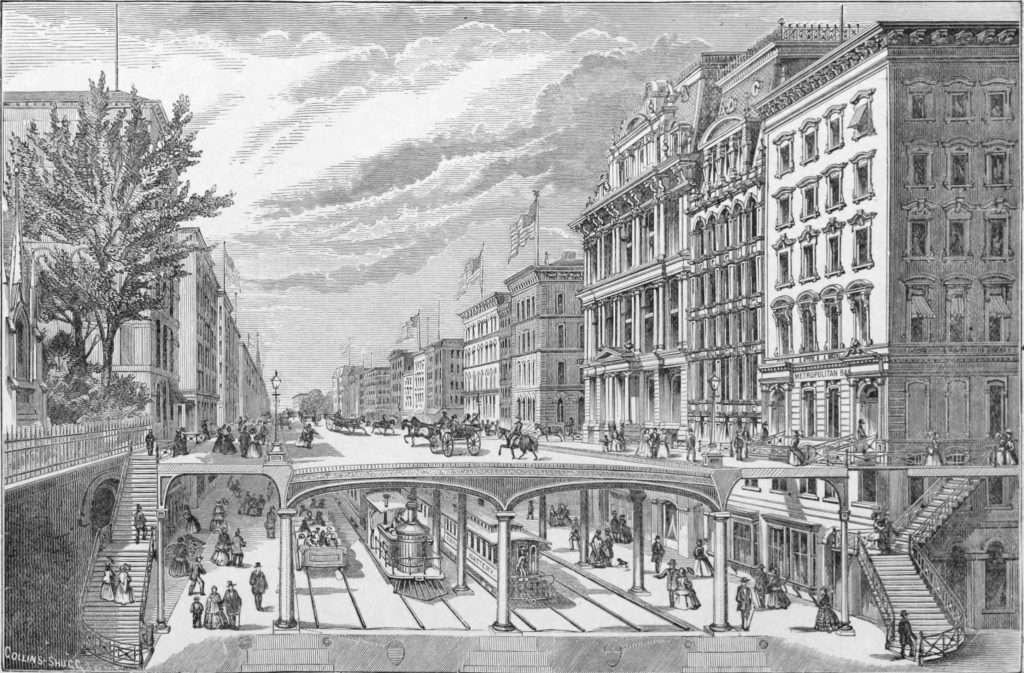
In the fall of 1879 Walker and his wife moved back to Binghamton. He resumed practicing law and became active in the state’s Democratic Party. In about 1881, Walker moved to New York City, where as attorney for the Broadway Underground Railway Company he endorsed plans to construct a long below-grade railroad down Broadway, which was never built. He may have become the company’s president shortly before his death. Gilbert Carlton Walker died of tuberculosis at his residence in New York on May 11, 1885. He was buried in Spring Forest Cemetery in Binghamton.


