

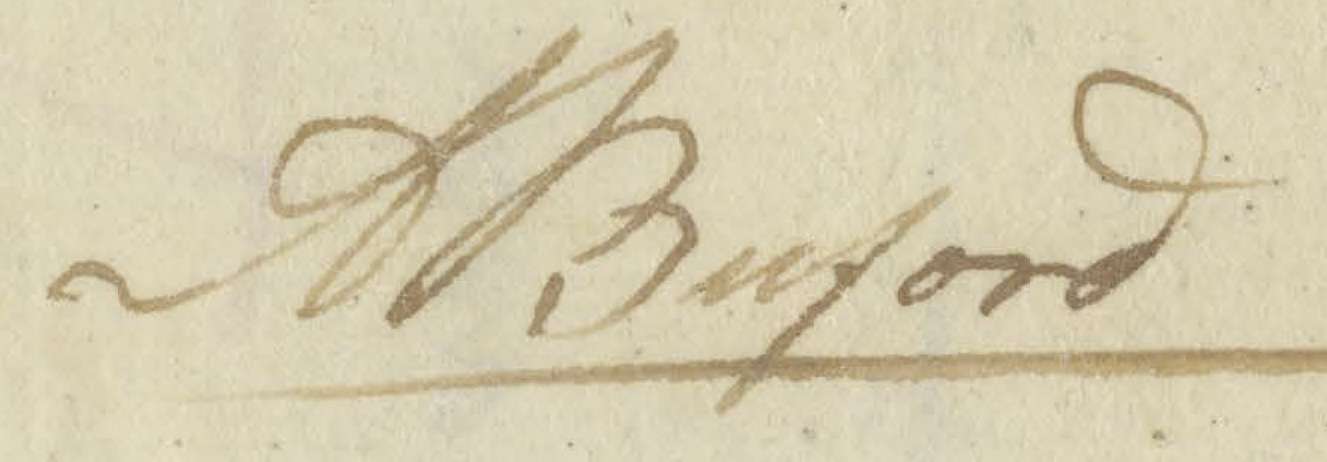
Buford was born in Culpeper County, the son of John Buford and Judith Early Buford. His immigrant ancestors had spelled the surname Beauford, but he always used the shorter spelling. Buford was one of the few Virginians to serve as an officer throughout the Revolutionary War. In 1775, he became the captain of a company of the Culpeper Minutemen and spent much of that winter of 1775–1776 and the ensuing year attached to the 2nd Virginia Regiment in the field near Norfolk. On November 13, 1776, Buford was commissioned a major in the 14th Virginia Regiment. He was promoted to lieutenant colonel of the 5th Virginia Regiment as of April 1, 1777, and to colonel on May 15, 1778. Buford spent the winter of 1777–1778 at Valley Forge, Pennsylvania, and fought at Monmouth Court House on June 28, 1778, before being transferred to the 11th Virginia Regiment. The following year, he saw action in several skirmishes in northern New Jersey, but in 1780 he returned home to recruit new troops for the defense of the southern states.
Stalemate in the North led the British to try a southern strategy. In 1780, they laid siege to Charleston, South Carolina, and Buford was given command of one of several Virginia units sent to reinforce the city. En route, he received word of Charleston’s capitulation on May 12, and he was then ordered to Camden to remove supplies and escort the governor of South Carolina, John Rutledge, to safety in North Carolina. Slowed by heavy wagons and muddy roads, Buford proceeded northward.

The British columns pushed deep into South Carolina and toward North Carolina to reestablish royal control. Their commander, General Charles Cornwallis, second earl Cornwallis, dispatched Lieutenant Colonel Banastre Tarleton and 270 British soldiers and Loyalists of his mixed cavalry-infantry legion in pursuit. Tarleton caught up with Buford, his 380 men, and a detachment of cavalry on May 29, 1780, at Waxhaw, in South Carolina near the North Carolina border. Tarleton called for Buford’s surrender, but Buford first delayed responding until Rutledge and the wagons were safe and then refused the demand. Tarleton ordered his heavy dragoons to crash into the center of the American defenses while his infantry and cavalry swept up the flanks. Overwhelmed, Buford offered to surrender and had his men lay down their arms. According to Tarleton’s account, his horse was shot from under him, and the British, seeing their commander go down, became inflamed and attacked the unarmed Americans with sabers and bayonets. According to American accounts, Tarleton deliberately ignored Buford’s white flag and unleashed his Loyalists to slaughter their fellow Americans at will.
The carnage was horrific. Buford lost 113 killed, 150 wounded, and 53 captured. Warfare in the South was immediately changed by “Bloody Ban” Tarleton’s perceived outrages. Whenever loyal and rebel Americans clashed thereafter, the niceties of eighteenth-century warfare were forgotten, but the Waxhaw killings were not. In October 1780 at Kings Mountain, American backwoodsmen shouted, “Give them Buford’s play,” when Loyalists under British major Patrick Ferguson tried to surrender. The following year, men under the command of Lieutenant Colonel Henry “Light-Horse Harry” Lee and Colonel Andrew Pickens cried, “Remember Buford,” as they butchered Loyalists at Haw River.
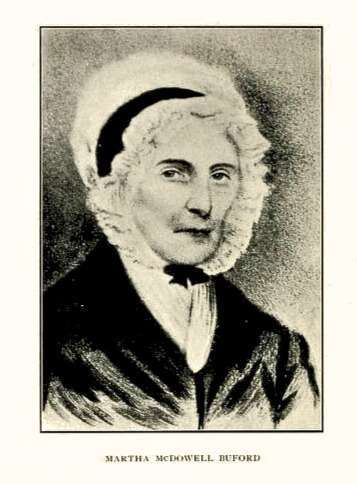
Buford was not among the officers captured at Waxhaw and remained in the army as commander of the 3rd Virginia Regiment until the end of the war. Entitled to more than 8,000 acres of land on the basis of his wartime service, he had moved to Lincoln County, Kentucky, by January 1783 and on October 4, 1788, married Martha McDowell, daughter of a fellow Virginia Continental army veteran. They moved to Georgetown in the area that in 1792 became Scott County and had five sons and one daughter. Working as a surveyor while speculating in land, Buford plotted out choice tracts in the bluegrass section and eventually held title to more than 50,000 acres. Evincing a longtime interest in racehorses, he was one of several Kentuckians who began to import prime racing stock from Virginia shortly after the turn of the century. Abraham Buford died at his home in Georgetown on June 26, 1833, during a cholera epidemic.


