

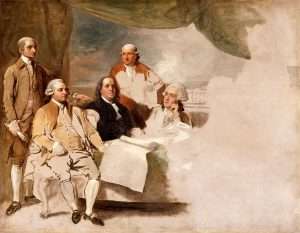
The Treaty of Paris was signed on September 3, 1783, and ratified by the Confederation Congress on January 14, 1784. The treaty officially ended the American Revolutionary War (1775–1783) between the United States and Britain. It formally recognized the United States as an independent nation, and importantly for Virginia, established a generous western boundary at the Mississippi River and promised open navigation of the river. It also stipulated that debts to British merchants be repaid in sterling, not depreciated Continental currency, and that Loyalist property be returned, conditions that Virginia was unwilling to meet. As a result, Britain allowed nearly 3,000 formerly enslaved people, many of them from Virginia, to leave for Nova Scotia in violation of the treaty. Spain’s closure of the Mississippi River and Native resistance in the Ohio Valley further complicated Virginia’s western ambitions. These unresolved tensions contributed to sectional divisions, debates over federal authority, and Virginia’s cautious support for a stronger national government under the U.S. Constitution, while continuing to shape the state’s political alignments and internal controversies into the 1790s.
ENTRY


